How do you convert a wool duvet's GSM to tog?
Updated .
Wool duvets from British, Australian and New Zealand sellers usually list their weight in GSM. The synthetic duvet you are replacing may have had a tog rating, and many US wool comforters give neither of these, only pounds of fill. This page converts the parts that really can be converted. For the rest, it shows what sellers' own pairings say.
Short answer: GSM can't be converted to tog exactly. GSM is the weight of the fill, and tog measures heat passing through the finished duvet. Sellers' own pairings give you a band to work with. About 200 gsm is sold as roughly 2 to 6 tog, and about 400 gsm as roughly 7 to 10.5 tog. For US listings, divide GSM by 33.906 to get ounces per square yard. A standard US queen at 350 gsm holds about 4 lb of wool.
This guide is for: people in the United States comparing wool comforters that list GSM, tog, or pounds of fill.
Key Takeaways
The figures below carry most of this page: what each unit measures, how far sellers disagree, and how GSM turns into the units sold in the United States.
- One tog is 0.1 m²K/W of thermal resistance, read off a finished duvet in a lab (Wikipedia, Tog (unit)). GSM is grams of fill per square meter. That is a weight, so it only tracks warmth within one maker's range, where the wool and the stitching stay the same.
- In the 10 seller pages we read, the same 200 gsm wool fill was sold as anything from 2 to 6 tog: 2 to 5 at Woolroom and 4 to 6 at Piglet in Bed. Treat any GSM-to-tog figure as a band, not a conversion.
- Divide GSM by 33.906 to get ounces per square yard, the standard unit conversion (SWATCHON). Weight is the one side of this question you can convert precisely, and the worked table below turns it into pounds of wool for a US queen and king.
On This Page
Each section below answers a single question. Read them in order, or jump to the one that matches the label in front of you right now.
What do GSM and tog each measure?
GSM is a weight: grams of fill per square meter. Tog is a heat reading taken on the finished duvet. One describes contents, the other warmth.
The two numbers come at warmth from opposite ends. GSM is grams of fill per square meter, so it tells you how much wool went into the duvet. Naturalmat describes its wool duvets this way: the gram figure on each one is the average weight of wool held in each square meter. Tog is a reading of heat flow through the finished duvet. F. T. Peirce and W. H. Rees of the Shirley Institute in Manchester devised the unit just after the Second World War as a measure of thermal resistance (Wikipedia, Tog (unit)). British duvet ratings come from a heated plate test that follows a British Standard method (IDFL). The International Organization for Standardization publishes its own method for measuring the thermal resistance of textiles, which reads the same kind of heat flow through a flat sample.
| GSM | Tog | |
|---|---|---|
| What it describes | Weight of fill per area | Resistance to heat passing through the whole duvet |
| Unit | Grams per square meter | A unit of thermal resistance |
| How it is found | Weigh the fill, divide by the area | Heated plate test on the finished duvet |
| Where you meet it | Wool and silk listings | British and Irish duvet labels |
| Same number, different fiber | Warmth can differ | Warmth should be similar |
If your old duvet had a tog number and your new one lists GSM, there is no exact bridge between them. The weight side converts exactly, and for warmth the best guide is the bands each seller publishes for its own wool duvets.
What do wool duvet listings state about GSM and tog?
We read ten seller pages. Four paired GSM with a tog figure, four gave GSM alone, and the last two gave only pounds of fill.
Our count: on September 26, 2026 we read 10 published seller pages that describe a wool-filled duvet or comforter by how much fill it holds. We sorted each page by what it states, and the count records those claims only, since we did no weighing or testing of our own.
- GSM plus a tog figure: 4 pages. Piglet in Bed, Scooms, Woolroom and Woolow.
- GSM with no tog figure: 4 pages. Naturalmat, Antipodean Home, SheepskinShop and Organic Comfort Market.
- Pounds of fill only, with no GSM and no tog: 2 pages. Frankenmuth Woolen Mill and Satara Home.
Most of the pages that give a tog figure give a range rather than a single number, and Woolow is the exception. None of the pages gave a clo figure, the American insulation unit covered further down.
The pattern matters more than any single page. Most sellers who use both systems present tog as a band, and that fits the physics explained further down. The pounds-only pages are the hardest to compare, so a later section shows how to turn them into GSM yourself.
What tog do sellers pair with each wool GSM?
Sellers do give tog figures for wool, but they disagree. The same light fill weight sits in a lower band on one page and a higher band on another.
If you put the sellers' own pairings side by side, you get bands, not a conversion factor. The table puts them together. The spread and reading columns are our judgement, a comparison no single maker publishes.
| Fill weight | Tog stated on seller pages | Spread across pages | Our reading |
|---|---|---|---|
| About 200 gsm | 4 to 6 (Piglet in Bed); 2 to 5 (Woolroom); about 4.5 for 200 to 300 (Scooms) | Wide | Summer, or a warm room |
| About 350 gsm | 8 to 10 (Piglet in Bed) | A single page | All-season middle; check each seller's own band |
| About 400 gsm | 10.5 (Woolow); 7 to 9 for 400 to 500 (Scooms) | Moderate | A cool room, or you run cold |
| 600 to 700 gsm | 10 to 13.5 (Scooms) | A single page | Winter, with too few pages to set a band |
Piglet in Bed and Woolroom both sell a light wool duvet at the same fill weight, yet the tog bands they state for it only partly overlap. Both can be honest. They may use different wool, different quilting, or a different idea of what "equivalent" means.
Use the middle of the spread as your starting point. If you are matching a synthetic duvet you already know, take the band's midpoint and then adjust for your room using the last section.
Why can't GSM be converted to tog exactly?
Warmth follows thickness more than weight. Two duvets with equal GSM can differ in how much air they trap, so no single formula links the two.
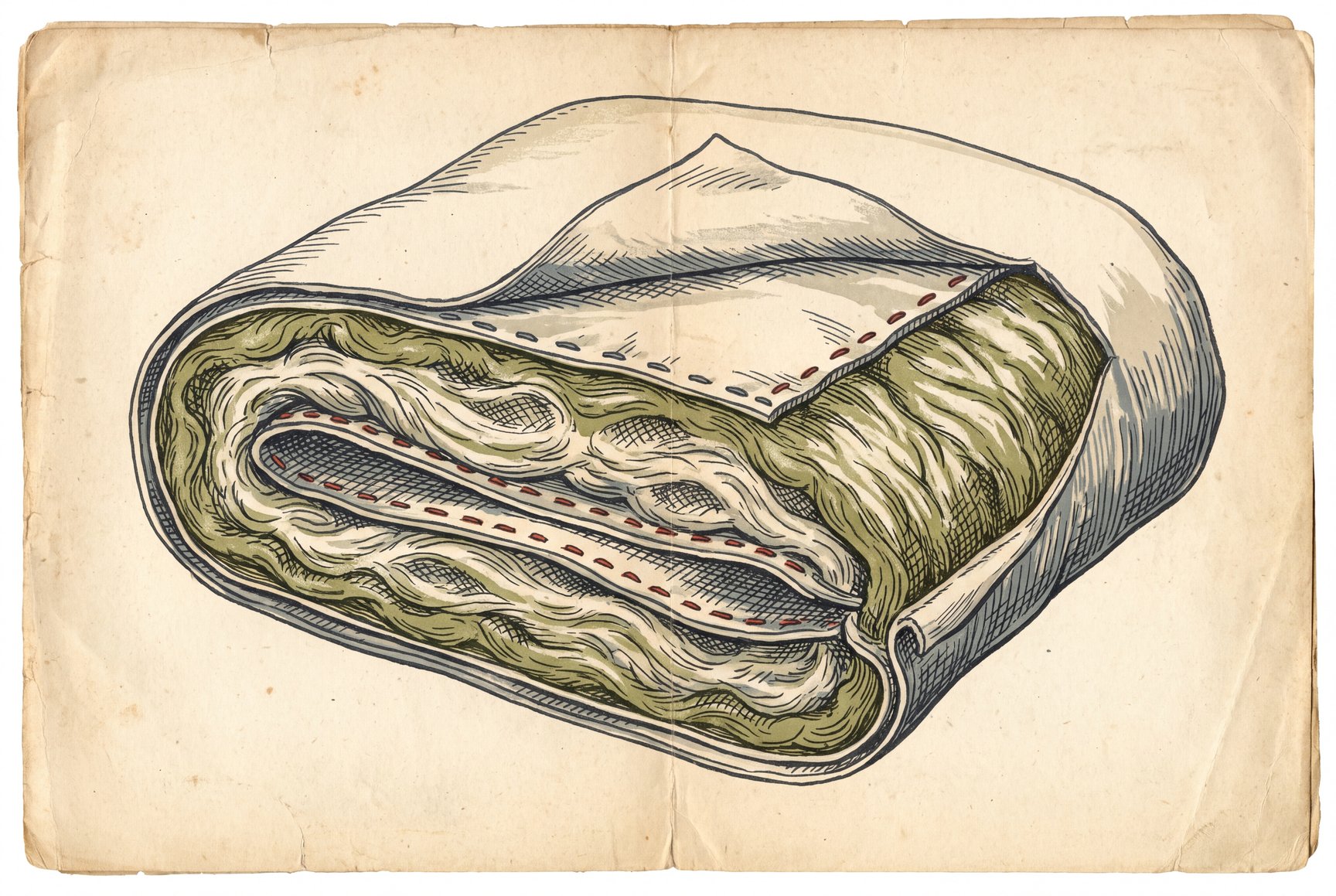
The clearest research answer comes from a study of quilt materials by Naylor, Wilson and Laing, published in the Textile Research Journal. It found that thermal resistance was primarily determined by sample thickness and largely independent of fiber type. Fabric references make the same point from the weight side: GSM measures weight per area, not thickness (SWATCHON). Weight would only predict warmth if every maker turned a gram of wool into the same thickness, and they don't. The wool's crimp, how the layers of wool are laid down and how tightly the duvet is stitched all change how much air a square meter holds.
So GSM predicts warmth well within one maker's range and poorly across makers. A seller's heavier duvet will be warmer than its own lighter one. It may not be warmer than a slightly lighter duvet from another seller, whose wool may stand thicker.
The tog test has its own limit, and it sits on the other side of the question. A tog rating is a lab comparison between finished products, taken on a flat sample under fixed conditions. It can rank one duvet against another, but it can't tell you how warm you will feel under a duvet that drapes over your shoulders in your own room. That is why sellers who print a tog figure for wool tend to call it approximate or "equivalent," and why a band is the honest way to read it.
How do you convert GSM to ounces and pounds?
Divide GSM by a fixed factor for ounces per square yard. For pounds of fill, multiply GSM by the area in square meters and divide by grams per pound.
Unlike GSM to tog, the conversion to US units is exact arithmetic. Fabric trade references give the factor plainly, and dividing GSM by the factor in the takeaways above gives ounces per square yard (SWATCHON). The US seller Organic Comfort Market states its fill in both units, and its figures agree with that factor.
For total fill, multiply GSM by the area in square meters and divide by the grams in a pound. The table uses a standard US queen and king, with the sizes given in the column headings, and every figure in it is our own arithmetic.
| GSM | Ounces per square yard | Queen (90 by 90 in), lb of wool | King (108 by 90 in), lb of wool |
|---|---|---|---|
| 200 | 5.9 | 2.3 | 2.8 |
| 350 | 10.3 | 4.0 | 4.8 |
| 400 | 11.8 | 4.6 | 5.5 |
These are fill weights only, and the cotton shell adds more. Antipodean Home says its queen weighs about a pound more in total than the wool inside it. Check which figure a listing gives before you compare two comforters.
If your bed is not a standard queen or king, the page on what size wool comforter you need for a king or queen bed covers the usual dimensions.
How do you check a US comforter that lists only pounds?
Divide the pounds of wool by the comforter's area. A standard queen holding four pounds of wool lands in the middle of the seller table.
Run the conversion backward. GSM equals pounds of wool times the grams in a pound, divided by the area in square meters. From the listing you need the pounds of wool (not the finished weight) and the comforter's dimensions in inches.
Frankenmuth Woolen Mill lists its queen as filled with four pounds of wool and its king with five, at the same sizes used in the table above. By the formula, the queen lands just under the middle row of our conversion table and the king just over it. Both fall in the all-season middle of the seller table, so you can compare either one with a mid-weight duvet from an overseas seller.
Some pages give pounds without dimensions. Satara Home gives queen fill in pounds for both a summer-weight and an all-season organic wool comforter, but without the queen's measurements you can't turn those into GSM. Look up the size on the product page first, because queen comforters vary by several inches between makers.
Make sure the pounds figure means wool, not the whole comforter. If a page says only "weight," assume it includes the shell. In that case your GSM result will run high, and the comforter will look warmer on paper than its wool can make it.
How does tog compare with the clo used in the United States?
One clo is worth about one and a half tog. The US and British figures come from different test methods, so do not set one beside the other.
The US has its own insulation unit, the clo, although wool comforter listings rarely use it. The clo is a larger unit than the tog, and it is described in an ASTM standard (Wikipedia, Tog (unit)).
The arithmetic is simple, but results from different tests are not interchangeable. The American clo test and the British tog test (IDFL) are separate methods, each with its own conditions. A clo figure from one and a tog figure from the other can describe the same duvet and still disagree once you convert between them.
For your purposes the clo mostly matters as a warning. If a US listing does give a clo figure, don't convert it to tog and set it next to a British tog rating as if the two came from the same test. If you do convert, treat the result as a rough guide to the order of warmth, not as a matching figure. No page in our count gave a clo figure, so you are more likely to meet GSM or pounds.
Which GSM should you pick for your bedroom?
Start from the room, not the number. A warm bedroom points to the lightest fill, a cool one to the heaviest, and most homes sit in between.
The British scale gives a sense of range. British Standard tog ratings run from a light summer duvet up to a heavy one for very cold winters, and central heating has made lighter ratings more popular (IDFL). For warm bedrooms, Piglet in Bed suggests a duvet from its lightest tog band. Research points the same way. A sleep study summarized by the Sleep Foundation found that heavier duvets gave sleepers a wider range of comfortable bedroom temperatures, reaching down into much colder rooms.
If you lay those onto the seller bands above, you get a rough guide. This is our judgement, not a standard:
- If your bedroom runs warm or you run hot, look at the lightest row of the seller table.
- If you have a heated home at ordinary settings, the middle row is the usual fit.
- If your room is cool or you run cold, choose from the heaviest rows.
A seller's own page points to the middle as the usual choice: Organic Comfort Market calls a mid-weight fill the standard for all-season wool comforters.
If you can't decide, a pair of lighter duvets can do the job of a heavy one. Several sellers make wool duvets that fasten together, and the guide on how to choose a wool duvet insert covers the fastening and cover questions that come with that setup.
Common questions
Short answers to the questions people ask most often when a wool comforter is listed in one unit and their old one used another.
Is a mid-weight wool duvet the same as a particular tog?
No single tog matches it. Scooms puts its lighter band, which reaches into the mid weights, at under five tog, while other sellers put nearby weights higher. Read it as a light-to-middle weight.
Does a higher GSM always mean a warmer duvet?
It does within one maker's range. Across makers, thickness matters more than weight, which is what the Textile Research Journal study found, so a well-made lighter duvet can match another seller's heavier one.
Why do some wool listings give no tog rating at all?
Several of the pages we read gave GSM without a tog figure. A tog test costs money, so many sellers stick to the weight, which they can state exactly.
Does GSM include the cotton shell?
On the pages we read, GSM described the wool alone. Pound figures vary more. A queen in our count weighed about a pound more in total than its wool alone, so check which figure you are reading.
Can you stack two wool duvets and add their GSM?
The weights add up exactly, and the warmth adds up roughly. Light duvets tied together hold the same wool as a heavier duvet, and the thin layers also trap a little air between them.
Is a washable wool comforter rated the same way?
Yes. It is sold by GSM or pounds just like any other wool comforter. The wool treatment changes how you care for it, not how you convert its weight. The guide to washable wool comforters covers that treatment.
Sources
Outside reading behind this wool duvet page, each entry marked with where on the page it is used.
- Wikipedia, Tog (unit) (en.wikipedia.org), used under “Key Takeaways”; “What do GSM and tog each measure?”; “How does tog compare with the clo used in the United States?”.
- Woolroom (thewoolroom.com), used under “Key Takeaways”; “What do wool duvet listings state about GSM and tog?”; “What tog do sellers pair with each wool GSM?”.
- Piglet in Bed (us.pigletinbed.com), used under “Key Takeaways”; “What do wool duvet listings state about GSM and tog?”; “What tog do sellers pair with each wool GSM?”; “Which GSM should you pick for your bedroom?”.
- SWATCHON (swatchon.com), used under “Key Takeaways”; “Why can't GSM be converted to tog exactly?”; “How do you convert GSM to ounces and pounds?”.
- Naturalmat (naturalmat.co.uk), used under “What do GSM and tog each measure?”; “What do wool duvet listings state about GSM and tog?”.
- IDFL (idfl.com), used under “What do GSM and tog each measure?”; “How does tog compare with the clo used in the United States?”; “Which GSM should you pick for your bedroom?”.
- its own method for measuring the thermal resistance of textiles (iso.org), used under “What do GSM and tog each measure?”.
- Scooms (scooms.com), used under “What do wool duvet listings state about GSM and tog?”; “What tog do sellers pair with each wool GSM?”; “Common questions”.
- Woolow (woolow.com), used under “What do wool duvet listings state about GSM and tog?”; “What tog do sellers pair with each wool GSM?”.
- Antipodean Home (antipodean-home.com), used under “What do wool duvet listings state about GSM and tog?”; “How do you convert GSM to ounces and pounds?”.
- SheepskinShop (sheepskinshop.com), used under “What do wool duvet listings state about GSM and tog?”.
- Organic Comfort Market (organic-comfort.com), used under “What do wool duvet listings state about GSM and tog?”; “How do you convert GSM to ounces and pounds?”; “Which GSM should you pick for your bedroom?”.
- Frankenmuth Woolen Mill (wool-bedding.com), used under “What do wool duvet listings state about GSM and tog?”; “How do you check a US comforter that lists only pounds?”.
- Satara Home (satarahome.com), used under “What do wool duvet listings state about GSM and tog?”; “How do you check a US comforter that lists only pounds?”.
- study of quilt materials by Naylor, Wilson and Laing (doi.org), used under “Why can't GSM be converted to tog exactly?”.
- Sleep Foundation (sleepfoundation.org), used under “Which GSM should you pick for your bedroom?”.