How is a wool duvet built, layer by layer?
Updated .
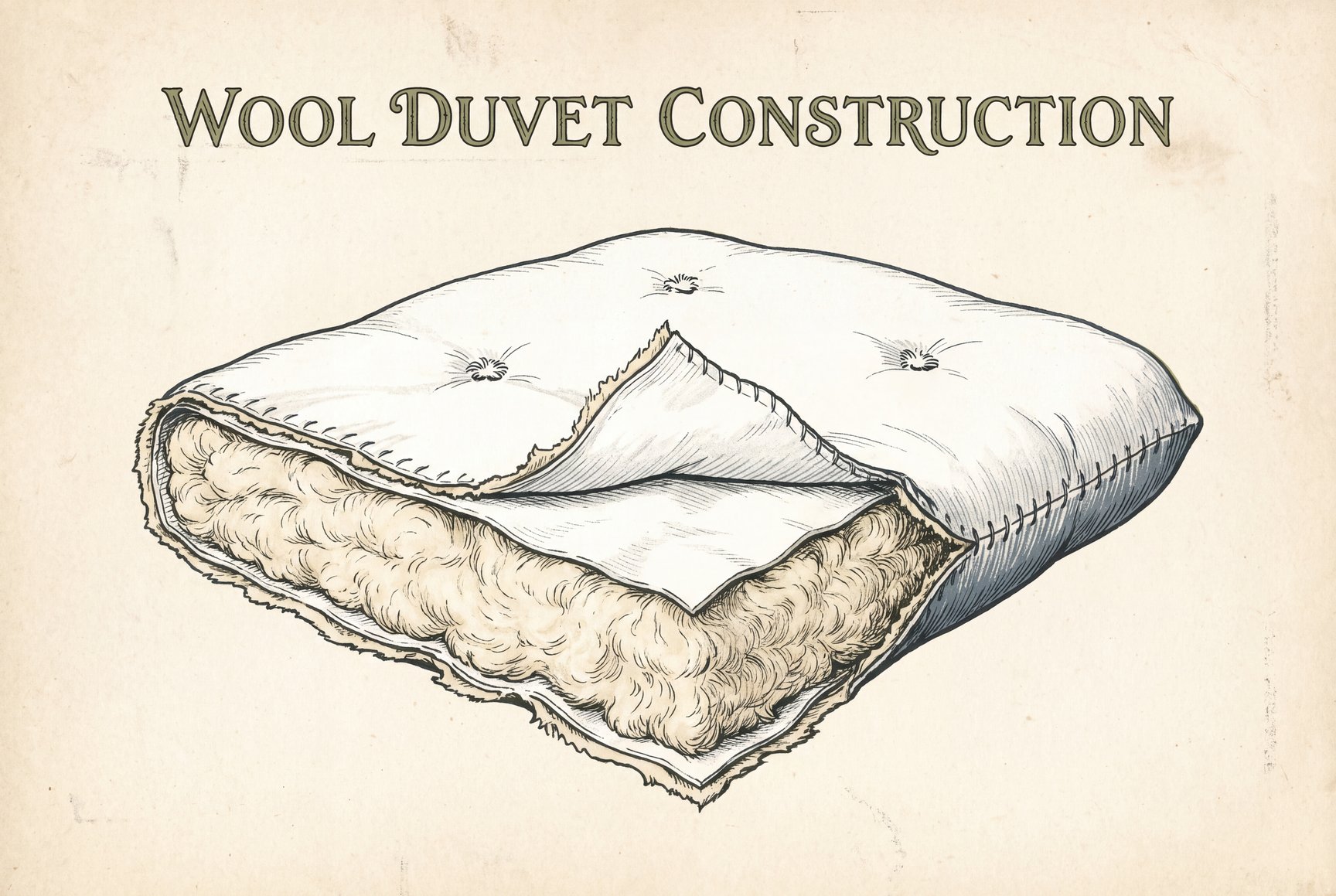
A wool duvet looks like one soft slab, but it has three working parts: layers of carded wool batting, a woven cotton shell, and the stitching that keeps the wool from sliding. The amount of wool matters most to how warm it feels, and it is the figure product pages most often leave out. Knowing the parts makes it easy to spot what a listing is missing and ask the seller for it.
Short answer: A wool duvet is layers of carded wool batting sealed inside a woven cotton shell and held flat by hand tufts, sewn channels or quilted boxes. The sellers we read put about 4 lbs of wool in a queen, close to 10 oz per square yard, and the shells they describe are cotton between 200 and 300 thread count. "Washable" can mean treated wool or just gentle hand washing, so the care label is worth reading. US rules require that label to list fiber percentages by weight.
This guide is for: people comparing wool duvets who want to know what sits inside the shell before they pay for one.
Key Takeaways
Three points cover most of what matters: how much wool is inside, how it is held in place, and what the label is required to say.
- A US-made queen wool duvet commonly holds about 4 lbs of wool. Two of the seller pages we read give that figure. Spread over a 90 by 90 inch queen, it works out to about 10.2 oz of wool per square yard (347 gsm). That figure is our arithmetic, not a number any seller prints.
- Only 2 of the 7 seller pages we read named the pounds of wool inside. Two gave a density or a weight that was not labeled as wool. Three gave no amount at all. Buyers often have to ask, and a good seller can answer in one line.
- Federal rules require a wool label to name every fiber that makes up 5% or more of the product by weight. Smaller amounts can be grouped as "other fiber." The sewn-in label is the one place the full fiber content has to appear, and a product page makes no such promise.
On This Page
The eight questions below follow the duvet from the inside out, starting with the wool and ending with the checks you can run yourself.
Each section opens with a one-line answer, then gives the figures and where they came from. The tables bring together what the seller pages we read say about layers, shells and stitching. For a quick read, the last section lists the questions to put to a seller before paying.
What layers make up a wool duvet?
A wool duvet has three parts you can name: layers of carded wool batting, a woven cotton shell around them, and stitching that pins the two together.
Open up almost any wool duvet and you will find much the same stack. The middle is wool batting, cleaned and carded, built up in layers. One US maker says it wraps its wool in all-cotton fabric. It then hand-tufts the duvet, with a row of stitching around the edge to hold the wool in place (Sonoma Wool Company). Small parts finish the job, such as corner loops you can tie inside a cover.
Some duvets have a fourth layer you can't see. A Minnesota mill that sews custom comforters says any wool it stitches that is not bonded must first be covered in cheesecloth, and that wool wrapped this way falls apart if slipped into a duvet cover (St. Peter Woolen Mill). That thin wrap holds loose fiber while it is sewn. Product pages rarely mention an inner wrap, so it is worth asking about.
| Layer | What it is | What to ask the seller (our judgement) |
|---|---|---|
| Wool batting | Soft layers of carded wool, full width or pieced | How many pounds of wool for my size? |
| Inner wrap (some duvets) | Cheesecloth or light fabric around the wool | Is there one, and what fiber is it? |
| Shell | Woven cotton: sateen, percale or muslin | What weave and thread count? |
| Stitching | Tufts, channels or quilted boxes | How far apart are the stitches? |
| Edge and loops | Perimeter seam, corner ties | Are there loops for a duvet cover? |
You can find a plainer overview of the item itself in what a wool duvet is.
How is raw wool turned into duvet filling?
Raw wool is washed, then carded by machine into a thin, even web that is laid down in layers until it covers the full size of the duvet.
Washing and combing are what turn greasy fleece into a filling that feels even across the bed. The St. Peter mill says washing new fleece can cut its weight by half or more (St. Peter Woolen Mill). A carding machine then combs the clean fibers into an even web, laid down layer on layer to build the batting, which is what gives the sleeper warmth without thin, cold patches.
The width of that machine decides whether the batting layers in your duvet run the full width of the bed or are pieced together. A Michigan mill writes that most such machines are narrow, while its own make a layer wide enough to skip piecing, which it says keeps the wool from moving (Frankenmuth Woolen Mill). St. Peter makes its wool in pieces smaller than a king, so a king takes one and a half pieces laid side by side and slightly overlapped (St. Peter Woolen Mill).
Some duvets skip the flat layer entirely. One seller's Airlay construction forms the wool into rounded clusters rather than one dense layer (Antipodean Home). Ask whether the batting runs full width, is pieced together or is loose clusters, because each one has to be held in place differently.
The wool is also where your sweat goes. Woolmark, a wool industry body, says wool can take up a lot of moisture before it feels wet. In warm, dry air it moves that vapor away from your skin to evaporate, so body heat leaves along with the damp (Woolmark).
How much wool goes into a wool duvet?
Queen wool duvets from the sellers we read hold about 4 lbs of wool, but many pages give a density or nothing, so you often have to ask.
We read 7 seller product pages for wool comforters and duvet inserts on September 26, 2026, and sorted each one by how its text states the amount of wool inside.
- Pounds of wool for a named size: 2 pages. Frankenmuth, Antipodean Home.
- A density, or a weight not labeled as wool: 2 pages. The Company Store, Lifekind.
- No amount in the text we read: 3 pages. Sonoma Wool Company, Turmerry, Holy Lamb Organics.
The tally reflects the wording on each page, so it shows what sellers disclose rather than what sits inside their duvets.
The pages that give pounds agree closely. Frankenmuth fills its queen with 4 lbs of wool and its king with 5 lbs (Frankenmuth Woolen Mill). Antipodean's queen holds 4.0 lb of wool inside a duvet that weighs 5.1 lb in all, which shows why a total weight can mislead (Antipodean Home).
If a page gives only a density, ask the seller to turn it into pounds of wool for the bed size. Density is written in grams per square meter, which most people in the US find hard to picture. The Company Store, for instance, lists its fill by density rather than by pounds (The Company Store).
What does the fabric shell do?
The shell keeps wool fibers inside and sets how the duvet sounds; sellers we read that give a thread count use cotton between 200 and 300.
The shell has one job you cannot see and one you can hear. It keeps short wool fibers inside, and its weave decides whether the duvet rustles or drapes quietly over the sleeper. The St. Peter mill cautions that wool may creep through fabric blended with polyester and says it prefers all-cotton fabric (St. Peter Woolen Mill).
| Seller page | Shell as stated | Thread count |
|---|---|---|
| The Company Store | Cotton percale | 200 |
| Holy Lamb Organics | Organic cotton sateen | 300 |
| Frankenmuth | Organic cotton sateen | Not given as a number |
On a wool duvet, thread count describes the weave, not the warmth. The wool does the insulating, and the shell mainly changes how the duvet feels and sounds. Sateen is smooth and drapes well, while percale and muslin feel crisper and plainer against your hand.
Sound matters to some people more than they expect. One buyer review on a seller page says two other wool comforters had outer cotton shells that were loud and crinkly when moving (Frankenmuth Woolen Mill). Light sleepers who mind noise can ask about the weave and handle a fabric sample if the seller offers one.
How is the wool held in place inside the shell?
Three methods hold the wool still: hand tufts with a stitched edge, sewn channels, or quilted boxes, and each one affects drape.
Loose wool will shift inside a shell unless something holds it. St. Peter sells a thin quilting-weight wool meant for close stitching, and a thicker comforter-weight wool for hand-tied comforters (St. Peter Woolen Mill). The same mill stitches all of its custom duvets in channels (St. Peter Woolen Mill).
Our count from the same 7 pages, sorted by the stitching method each one states:
| Method stated | Pages | Count | What it means for you (our judgement) |
|---|---|---|---|
| Hand tufts plus a stitched perimeter | Sonoma, Holy Lamb, Turmerry | 3 | Fewer seams and a softer drape; check the tufts after each wash |
| Machine quilting in channels or boxes | Lifekind | 1 | More seams holding the fill, flatter along each line |
| Not stated in the text we read | Frankenmuth, The Company Store, Antipodean | 3 | Ask before you buy |
The tufted group includes Turmerry, and Lifekind is the one page in the set that describes quilting.
Closer stitching holds the fill better, and wider spacing lets it drape more. That is our reading of the trade-off, not a claim any seller makes. The right choice depends on how often the insert will be washed and how it should fall across the bed. If you plan to wash at home, ask the seller whether washing can pull the wool loose between the seams.
What changes when a wool duvet is made washable?
Washable wool can mean fiber treated to resist felting or a design meant for gentle washing, and the two are not the same promise to you.
Wool felts because each fiber has tiny surface scales that lock together under heat, water and rubbing. A research article on shrink-proofing calls chlorine-Hercosett treatment the most commonly used industrial technique, and notes drawbacks including the emission of chlorine compounds (PMC research article). Wool sold as machine washable may well have been through a process like this one.
On product pages, "washable" covers very different instructions. Frankenmuth calls its comforter washable. Its care directions, though, call for hand washing in lukewarm water with a mild detergent, and the page says the design is meant for hand washing rather than machine agitation (Frankenmuth Woolen Mill). The same word on another seller's page may mean a gentle machine cycle, so the care label is what tells you which kind you have.
Read the care instructions, not the word "washable." If you want to machine wash, ask whether the wool is treated to resist shrinking and how the layer is stitched. Our guide to washable wool comforters goes through your options in more detail, including whether a washable one can also be organic.
What do labels and certifications tell you about the layers?
A US wool label must give fiber percentages by weight, and an organic claim is only as broad as the certificate that covers the finished duvet.
Under the federal wool rules, the label must give the percentages by weight of wool, recycled wool and any other fiber above a set share of the product. It must also identify the maker and the country where the product was made (Federal Register). Fibers under that line can be grouped as "other fiber," though the wool percentage must always be stated (eCFR).
Organic claims work in grades under GOTS, the Global Organic Textile Standard. Its top grade asks that nearly all of the fiber in a finished product be organic, while a lower grade allows a smaller organic share. The question to ask is whether the certificate names the finished duvet, not only its wool or its fabric.
OEKO-TEX answers a different question. Its Standard 100 label means a product was tested and found free of harmful substances at levels that could affect your health (Kothea). It says nothing about how the wool was farmed. Our page on what makes an organic wool comforter organic covers how the grades apply to each layer you are buying.
How can you check a wool duvet's construction before you buy?
Ask four things: pounds of wool for your size, how the wool is held, what the shell is, and whether the certificate covers the finished piece.
Start with the wool, and ask for the pounds of wool in your size, not the total weight of the duvet, because a total includes the shell. If the seller gives only a density, ask for it converted to pounds, then compare the answer with the queen figure in the takeaways above. A seller who knows the product should be able to reply without looking it up.
Next, ask whether the batting layers inside the shell run full width or are pieced. Full-width layers, overlapped pieces and loose clusters all behave differently, and a king is where piecing is most likely, given how narrow most of the machines are.
Then ask how the wool is stitched in place. Tufts, channels and quilted boxes all work, but the spacing matters, and so does whether the seller expects the insert to be washed at home. Ask for the shell's weave and thread count as well, and confirm that the fabric is all cotton.
Finally, read the sewn-in label when the duvet arrives. The label must list every fiber above the federal threshold by weight, so any polyester above that line has to appear there for you to see. If the duvet claims to be organic, check that the certificate covers the finished item you received, not just one of its materials.
Common questions
Short answers to the questions people ask most often about what sits inside a wool duvet and how the parts hold up over time.
Is a wool duvet the same as a wool comforter?
In US listings the two words usually mean the same filled insert. Sonoma, for one, sells a "comforter" with corner loops for duvet ties (Sonoma Wool Company), so it works like a duvet insert.
Does the wool absorb sweat through the shell?
Yes, because the cotton shell lets water vapor through to the wool. Woolmark says that in warm, dry air wool moves that vapor away from your skin to evaporate, which carries heat off with it (Woolmark).
Is there evidence a wool duvet improves sleep?
It is limited. One small trial compared wool with polyester bedding in young adults at a cool and a warm room temperature (Nature and Science of Sleep), and a single small study cannot tell you how a duvet will work in your own bedroom.
Can a "wool" duvet contain polyester?
Yes, in small amounts, since fibers below the federal threshold can appear on the label as "other fiber." The Company Store states there is no polyester in its comforter (The Company Store).
What does "recycled wool" mean on a label?
It means wool returned to a fibrous state after being woven, knitted or felted, whether or not anyone ever used the product (FTC). The label has to list it separately from new wool.
Why can wool shrink in the wash?
Each wool fiber has tiny surface scales that lock together under heat, water and rubbing, which is called felting. A research review names chlorine-Hercosett as the most common industrial treatment used to stop it (PMC research article).
Sources
Outside reading behind this wool duvet page, each entry marked with where on the page it is used.
- Sonoma Wool Company (sonomawoolcompany.com), used under “What layers make up a wool duvet?”; “Common questions”.
- St. Peter Woolen Mill (woolenmill.com), used under “What layers make up a wool duvet?”; “How is raw wool turned into duvet filling?”; “What does the fabric shell do?”; “How is the wool held in place inside the shell?”.
- Frankenmuth Woolen Mill (wool-bedding.com), used under “How is raw wool turned into duvet filling?”.
- St. Peter Woolen Mill (woolenmill.com), used under “How is raw wool turned into duvet filling?”; “How is the wool held in place inside the shell?”.
- Antipodean Home (antipodean-home.com), used under “How is raw wool turned into duvet filling?”; “How much wool goes into a wool duvet?”.
- Woolmark (woolmark.com), used under “How is raw wool turned into duvet filling?”; “Common questions”.
- Frankenmuth Woolen Mill (wool-bedding.com), used under “How much wool goes into a wool duvet?”; “What does the fabric shell do?”; “What changes when a wool duvet is made washable?”.
- The Company Store (thecompanystore.com), used under “How much wool goes into a wool duvet?”; “What does the fabric shell do?”; “Common questions”.
- Holy Lamb Organics (holylamborganics.com), used under “What does the fabric shell do?”.
- Turmerry (turmerry.com), used under “How is the wool held in place inside the shell?”.
- Lifekind (lifekind.com), used under “How is the wool held in place inside the shell?”.
- PMC research article (ncbi.nlm.nih.gov), used under “What changes when a wool duvet is made washable?”; “Common questions”.
- Federal Register (federalregister.gov), used under “What do labels and certifications tell you about the layers?”.
- eCFR (ecfr.gov), used under “What do labels and certifications tell you about the layers?”.
- Kothea (kothea.com), used under “What do labels and certifications tell you about the layers?”.
- Nature and Science of Sleep (dovepress.com), used under “Common questions”.
- FTC (ftc.gov), used under “Common questions”.