What makes an organic wool comforter organic, and is it worth it?
Updated .
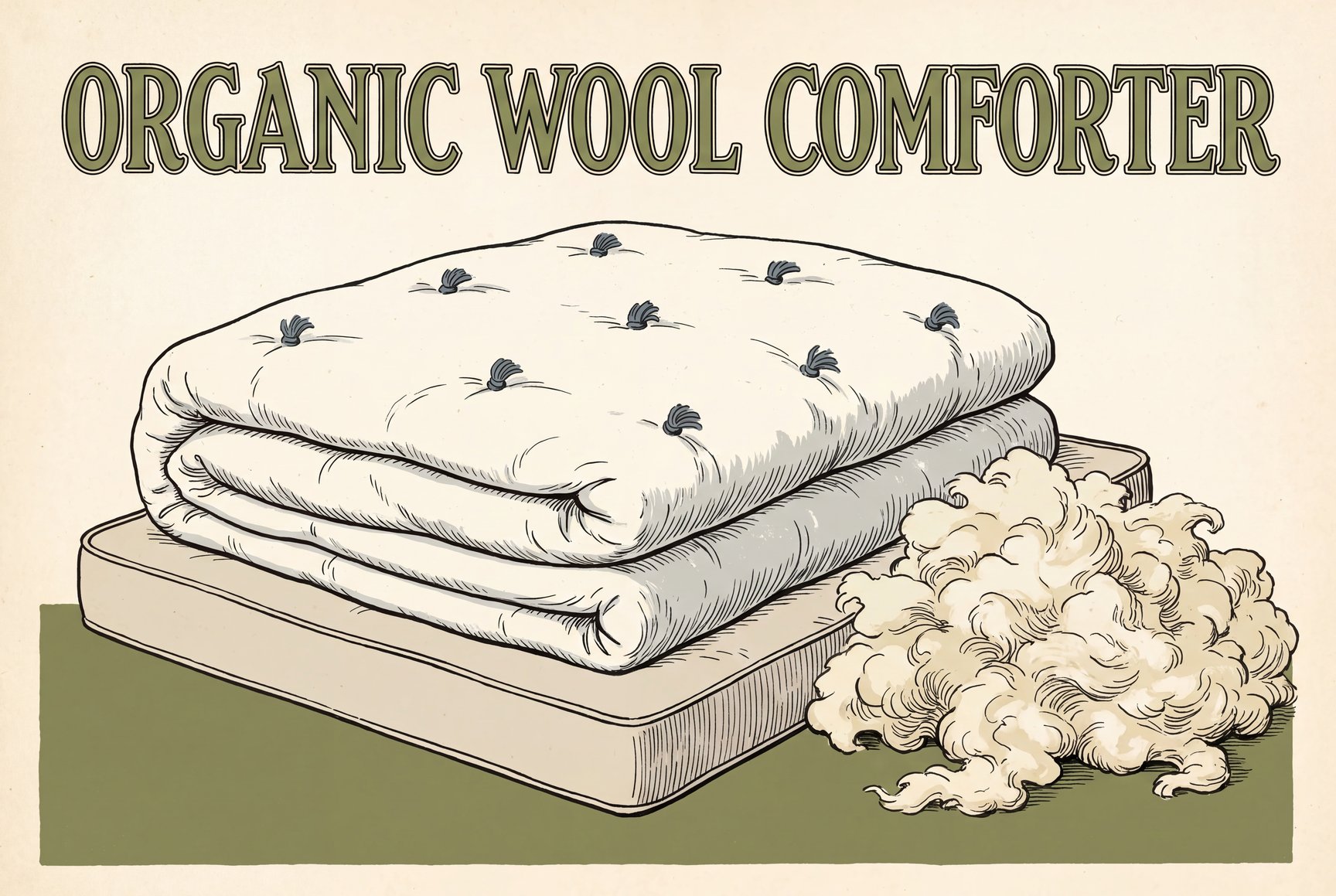
An organic wool comforter is a quilted cotton shell filled with wool from certified organic farms. In the United States, the word "organic" on one depends on a private textile standard, not on the USDA seal most shoppers know from food. This page explains what that standard checks, how often seller pages let you verify it, how warm each fill weight runs, and what the sleep research does and does not show.
Short answer: A wool comforter is organic when the finished product is certified to the Global Organic Textile Standard (GOTS), whose "organic" grade requires at least 95% certified organic fibre (GOTS labelling). Look for the certifier's name beside the claim, then ask the seller for the scope certificate behind it. Organic status tells you how the sheep were farmed and the wool processed. It does not make the comforter warmer, and we found no study comparing organic with conventional wool for sleep.
This guide is for: people in the United States choosing a twin, queen or king wool comforter who want the organic claim to mean something they can check.
Key Takeaways
These are the three points to take into any shop: what the organic grade requires, how often listings let you check it, and what the sleep research found.
- GOTS "organic" means at least 95% certified organic fibre, and every company that processes the product must be certified (Global Standards). The looser "made with organic" grade allows a share of conventional fibre (GOTS labelling). In the U.S., textiles that meet GOTS may be sold as organic, but only finished products certified to USDA rules may use the USDA organic seal (USDA AMS).
- Of 8 seller pages we read, 3 printed their GOTS certificate details. Another three claimed GOTS without them, and two used "organic" for the cotton shell only. On most of these pages, checking the claim falls to you.
- A 2016 study found no bedding effect on sleep when wool bedding replaced polyester (Shin and colleagues). The measured wool benefits came from sleepwear, and we found no study that compares organic wool with conventional wool.
On This Page
These are the eight questions this guide answers, in order. Each has a short answer under its heading, and the sources are linked in the text below it.
What makes a wool comforter organic?
A wool comforter is organic when the finished item is certified to GOTS, which covers the farm, every processor and the label on the product.
Raw wool is a farm product, so the organic part starts with the sheep. The USDA says textiles that meet GOTS may be sold as organic in the U.S., but the USDA organic seal belongs only on finished products certified to its own rules (USDA AMS). Its enforcement guidance adds that uncertified clothing made with organic textiles falls outside the USDA organic regulations altogether (USDA AMS FAQ). For a wool comforter, that leaves GOTS as the standard you are most likely to see on the listing.
GOTS has two main grades, "organic" and "made with organic", and the second allows a share of conventional fibre (GOTS labelling). When a seller uses the "made with" grade, GOTS rules say the consumer-facing claim should state the exact percentage of certified organic fibre along with the certification details (Global Standards). Every company involved in processing must be certified by an approved independent body (Global Standards).
The practical point is that the certification has to cover the finished comforter, not one part of it. One certification body approved under GOTS states that the entire supply chain must be certified before the finished product can carry the GOTS label (USB Certification). A comforter with an organic cotton shell around ordinary wool is a real product, and often a good one. You are still not buying an organic wool comforter when you buy it.
How many organic wool comforters show their GOTS certificate details?
Of eight seller pages we read, three printed GOTS certificate details, three claimed GOTS without them, and two meant the cotton shell only.
We read 8 US-facing seller pages for comforters marketed as organic wool, on 25 September 2026, and counted what each page states about certification. This is a count of published text. Nothing was bought, handled or tested, and details printed only on the product itself would not appear here.
- Certificate details on the page (3 of 8): Woolroom, Sleep & Beyond, and Natural Linens, whose listed certificate covers its wool fill.
- GOTS claimed, no certificate details in the text we read (3 of 8): Holy Lamb Organics, Sleeping Organic, and a Delara listing on Walmart.
- "Organic" in the name, fill not claimed as certified organic (2 of 8): Antipodean Home describes regenerative New Zealand wool inside an organic cotton shell, and Magnolia Organics fills GOTS-certified organic sateen with eco-wool.
The count says nothing about quality. A page without certificate details may belong to a fully certified maker, and you can simply ask the seller for them. What the count does show is that a quarter of these listings used "organic" for the shell alone, which is easy to miss when the word sits in the product name. It also shows that on most pages you do the checking yourself, so the next section covers how.
How can you check an organic wool comforter's certification?
Find the certifier's name next to the GOTS claim, then ask the seller for the scope certificate and check that it names bedding.
Start with the listing itself. A complete GOTS claim names the grade and carries the certification details that GOTS requires alongside it (Global Standards). The certificate a listing refers to may belong to the company that made the comforter rather than the shop selling it, which is normal and not a warning sign.
The document that settles the question is the scope certificate. The certification body issues it, and its products appendix shows what is covered and at which grade, including whether a product is only "organic in-conversion" (GOTS labelling). Ask the seller for it before you pay. When it arrives, check that the company named matches the maker, that the dates are current, and that comforters or bedding appear in the product list. If the seller cannot send it, treat the claim as unconfirmed until you hear otherwise.
The table below is our judgement of what each thing a listing shows is worth. No seller publishes this.
| What the listing shows | What it proves | What to do |
|---|---|---|
| GOTS claim with certificate details | The claim can be checked | Ask for the scope certificate and confirm it lists bedding |
| GOTS claim, no certificate details | Nothing yet | Ask for the certificate before you buy |
| Organic cotton shell with "eco-wool" or "pure wool" fill | The shell is organic; the fill is not claimed to be | Judge it as a conventional wool comforter |
| OEKO-TEX label only | The item passed tests for harmful substances (OEKO-TEX) | Useful, but it says nothing about farming |
| USDA organic seal | Should mean the finished product meets USDA rules (USDA AMS) | Ask which certifier issued it |
How warm is an organic wool comforter?
Warmth follows fill weight, not the organic label. One seller rates its medium weight for bedrooms of 60 to 68°F; heavier fills suit colder rooms.
Wool does not puff up the way down does, so the number that matters is fill weight, given as grams per square meter (GSM) or ounces per square yard. A king at a given weight simply holds more wool than a twin, so you should compare the per-area figure rather than the total weight in the box. Organic certification does not change this, and we would expect certified and conventional fills of equal weight to feel alike in warmth.
Only one seller we read ties its weights to room temperature. Woolroom rates its light organic comforter for warm rooms and its medium for cooler ones (Woolroom). We used those two bands to place a heavier fill below. That placement is our judgement from the numbers, not a test, and if you sleep hot or share a bed you may want one step lighter. Our guide to buying a wool comforter covers sizing and fill in more depth.
| Organic comforter | Stated fill | Seller's room band | Our reading (judgement) |
|---|---|---|---|
| Woolroom light | Light | 68°F and up | Summer, or warm sleepers all year |
| Woolroom medium | 350 GSM | 60 to 68°F | Most of the year in a heated home |
| Natural Linens | 530 GSM | None published | Cold rooms or people who run cool |
Does an organic wool comforter help you sleep better?
We found no study testing organic against conventional wool. A lab study that swapped wool bedding for polyester found no effect on sleep.
Bedding was tested directly in a University of Sydney study. Young adults slept in a cool room and a mild one under wool or polyester bedding, and the authors reported no bedding effect on sleep (Shin and colleagues). In that study, wool sleepwear did shorten the time it took people to fall asleep compared with cotton.
A later study of adults in their fifties and sixties, sleeping in a warm room, found small benefits for wool sleepwear, especially for older and poorer sleepers (Chow and colleagues). Some authors of both papers worked for Australian Wool Innovation, the wool industry body, as the journal pages state. Neither study tested a comforter by its organic status, and we found no study that does.
The property behind the claims is real. The Chow paper notes that dry wool can absorb about a third of its own weight in moisture from saturated air, far more than cotton or polyester (Chow and colleagues). That matters because sweat carries body heat. As the fibre draws damp away from your skin, the heat leaves with the damp, so you stay drier and cooler than under a fill that holds moisture against you. You can expect that from any wool comforter. Organic certification changes how that wool was farmed and processed, not how you sleep under it.
Can you wash an organic wool comforter?
Some can go in a machine on a wool cycle and dry on a line; others felt and shrink if washed. The care line on the product page decides it.
Organic status says nothing about washing. What matters is whether the wool was treated to resist felting and how the comforter is quilted, so read the care instructions before you buy, not after the first spill.
The pages we read split three ways. Woolroom sells its organic comforter as machine washable, but it advises against tumble drying and vacuum storage (Woolroom). The Sleep & Beyond page we read said the opposite for its organic comforter, warning that machine washing or drying can felt the fill and ruin it. Natural Linens recommends spot cleaning the shell with a soft brush, a short, low-moisture eco dry clean for major stains, and regular airing in the sun (Natural Linens).
| Care route | Example from a seller page | What it asks of you |
|---|---|---|
| Machine wash | Woolroom: wool cycle, low spin, line dry | A large machine and room to dry a queen |
| Spot clean and air | Natural Linens: brush the shell, air in sun, eco dry clean for major stains | A cleaner who handles wool bedding |
| Do not wash | Sleep & Beyond: no machine washing or drying | A cover you wash instead |
All three sellers point the same way on daily care: a duvet cover does most of the work, and you wash it far more often than the comforter. If washing is your deciding factor, our page on washable wool comforters explains how the treatment works and whether it fits an organic claim.
How much does an organic wool comforter cost?
Prices follow size and fill weight more than the organic label, and one maker charges only slightly more for its certified organic version.
Price follows size, fill weight and where the comforter is made more than it follows the organic claim. Sellers price each size separately, and Organic and Healthy, for example, lists its comforters as price ranges that run from the smallest size to the largest. Compare prices size for size, rather than against the lowest "from" figure on a listing.
You get the clearest view of what organic adds when one maker sells both versions. Holy Lamb Organics lists its All-Natural Wool Comforter from $239 and its Certified Organic Wool Comforter from $259, so the certified version costs a little more at the entry price (Holy Lamb Organics). Its natural line uses domestically sourced eco wool inside an organic cotton sateen shell (Holy Lamb Organics). If the farming standard is what you are paying for, that small gap is the price of it at this maker.
Returns matter as much as price. Woolroom offers a sleep trial on its organic medium comforter (Woolroom). Holy Lamb treats its all-season comforters as custom, nonreturnable items and offers sample kits to help you choose (Holy Lamb Organics). Ask about returns before you pay, because a wool comforter that turns out too warm is a costly mistake to keep.
Is an organic wool comforter the same as an organic wool duvet?
Yes. In the United States both names describe one wool-filled, quilted insert; you can use it bare or slide it inside a washable duvet cover.
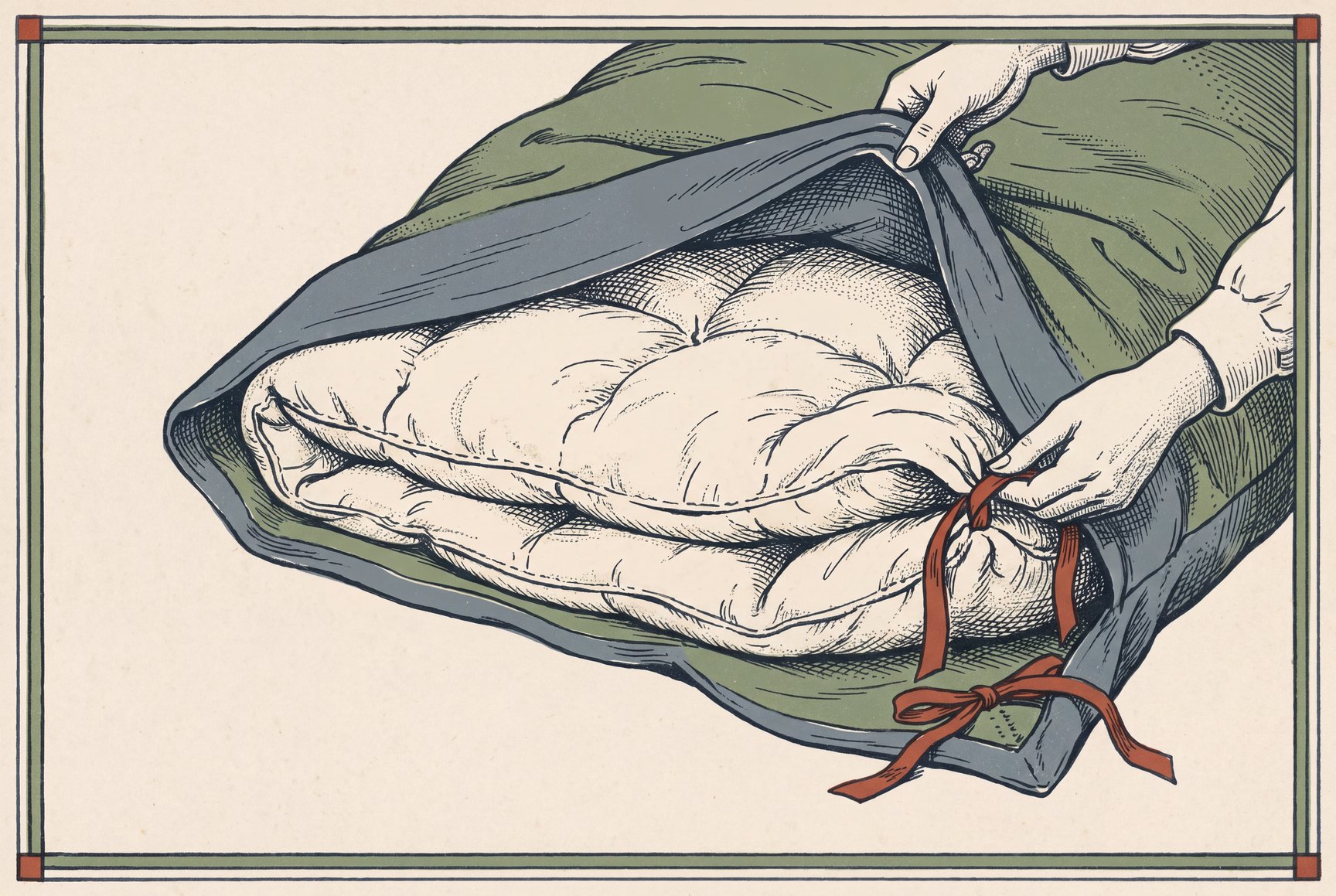
Both search terms name one product. Woolroom states on its product page that a wool duvet, a duvet insert and a wool comforter are one item, and that the name you use depends on where you live (Woolroom). Many US listings now use both words in one title, so you can search with either and see much the same results.
The real differences are in how the insert sits in a cover. Look for corner ties or tabs, which stop the insert sliding to the foot of the cover while you sleep. Holy Lamb adds corner ties to its certified organic comforters (Holy Lamb Organics). If a comforter has no ties, a cover with inside ties will not help you, and the insert will bunch.
Size needs care as well. Antipodean Home's queen (Antipodean Home) and Holy Lamb's all-season full/queen (Holy Lamb Organics) are cut to different dimensions. Match the insert to your cover's measurements, not just to the word "queen".
Most sellers still recommend a cover, since it is the part you wash and it protects the shell from wear. For fastening and fit in more depth, see how to choose a wool duvet insert.
Common questions
Short answers to common questions about organic wool comforters, each one drawn from the sources cited in the sections above.
Is organic wool better for allergies?
Several sellers, including Woolroom, say wool suits people with allergies. Sellers explain that lanolin keeps dust mites out and that wool keeps the bed drier than mites need. None of the sleep studies cited here tested allergies, so treat this as a seller claim.
Can a comforter be organic if only the cover is organic?
Not under GOTS. The entire supply chain must be certified for the finished product to carry the GOTS label (USB Certification). The listing should say the wool fill itself is certified.
Is "made with organic" wool good enough?
It depends on what you want. The grade means at least 70% of the fibre is certified organic (GOTS labelling), and the claim should state the exact share.
Will an organic wool comforter be too hot in summer?
That depends on the weight. Woolroom rates its light organic comforter for rooms of 68°F and up (Woolroom), so a heavy fill is a winter weight by comparison.
Can I see a comforter's GOTS certificate?
Yes. Ask the seller for the scope certificate, whose products appendix shows what is certified and at which grade (GOTS labelling).
Is regenerative wool also organic?
Not by that word alone. Antipodean Home describes regenerative New Zealand wool in an organic cotton shell (Antipodean Home), but a regenerative claim is not a GOTS certificate for the fill.
Sources
Outside reading behind this wool duvet page, each entry marked with where on the page it is used.
- GOTS labelling (global-standards.org), used under “Key Takeaways”; “What makes a wool comforter organic?”; “How can you check an organic wool comforter's certification?”; “Common questions”.
- Global Standards (global-standards.org), used under “Key Takeaways”; “What makes a wool comforter organic?”.
- USDA AMS (ams.usda.gov), used under “Key Takeaways”; “What makes a wool comforter organic?”; “How can you check an organic wool comforter's certification?”.
- Shin and colleagues (pubmed.ncbi.nlm.nih.gov), used under “Key Takeaways”; “Does an organic wool comforter help you sleep better?”.
- USDA AMS FAQ (ams.usda.gov), used under “What makes a wool comforter organic?”.
- USB Certification (usbcertification.com), used under “What makes a wool comforter organic?”; “Common questions”.
- Woolroom (thewoolroom.com), used under “How many organic wool comforters show their GOTS certificate details?”; “How warm is an organic wool comforter?”; “How much does an organic wool comforter cost?”; “Is an organic wool comforter the same as an organic wool duvet?”; “Common questions”.
- Natural Linens (naturallinens.com), used under “How many organic wool comforters show their GOTS certificate details?”; “How warm is an organic wool comforter?”; “Can you wash an organic wool comforter?”.
- Holy Lamb Organics (holylamborganics.com), used under “How many organic wool comforters show their GOTS certificate details?”; “Is an organic wool comforter the same as an organic wool duvet?”.
- Antipodean Home (antipodean-home.com), used under “How many organic wool comforters show their GOTS certificate details?”; “Is an organic wool comforter the same as an organic wool duvet?”; “Common questions”.
- Magnolia Organics (magnoliaorganics.com), used under “How many organic wool comforters show their GOTS certificate details?”.
- OEKO-TEX (oeko-tex.com), used under “How can you check an organic wool comforter's certification?”.
- Woolroom (thewoolroom.com), used under “How warm is an organic wool comforter?”; “Can you wash an organic wool comforter?”; “Common questions”.
- Chow and colleagues (dovepress.com), used under “Does an organic wool comforter help you sleep better?”.
- Organic and Healthy (organicandhealthy.com), used under “How much does an organic wool comforter cost?”.
- Holy Lamb Organics (holylamborganics.com), used under “How much does an organic wool comforter cost?”.
- Holy Lamb Organics (holylamborganics.com), used under “How much does an organic wool comforter cost?”; “Is an organic wool comforter the same as an organic wool duvet?”.