Is a wool or down comforter better for your bed?
Updated .
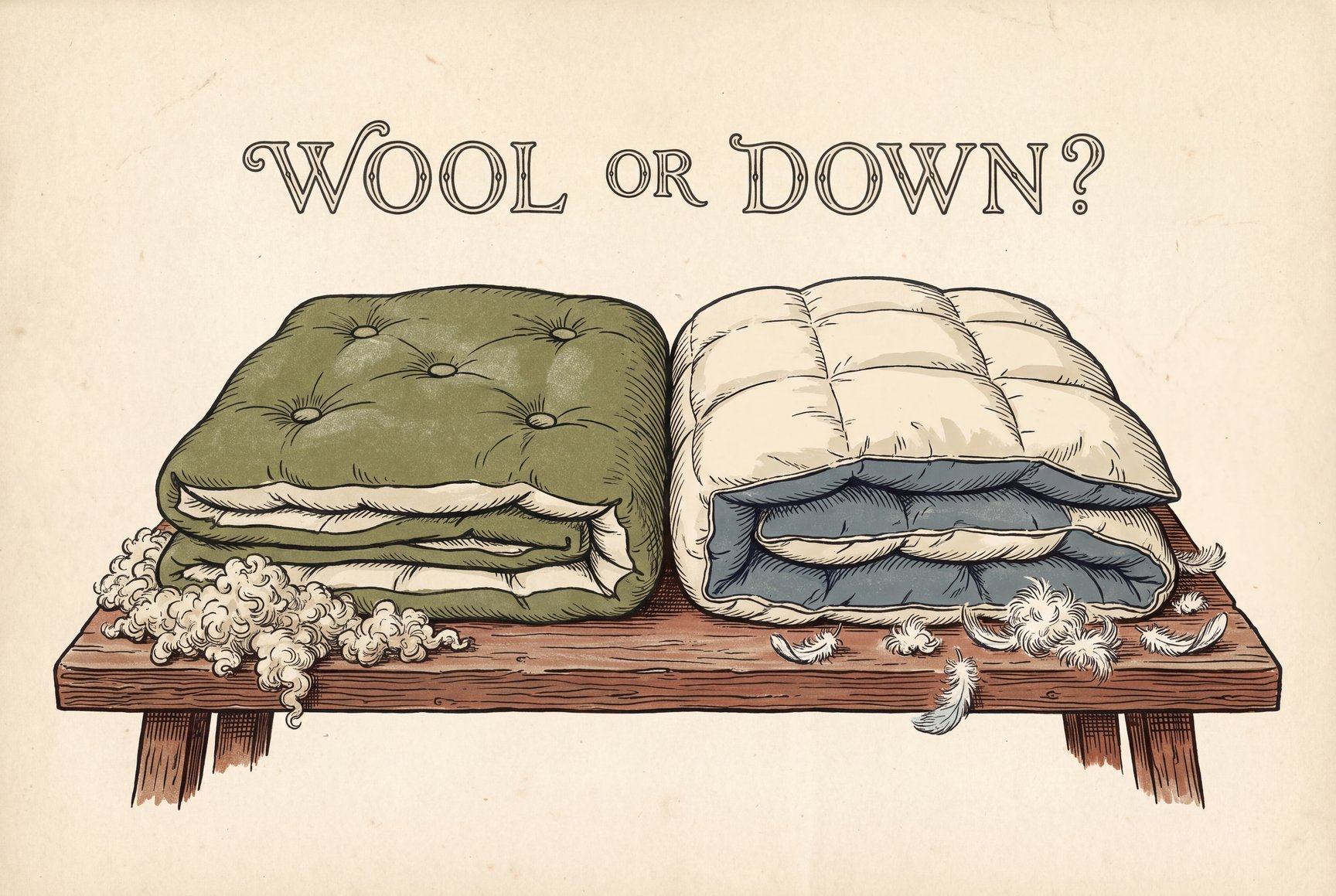
A wool comforter and a down comforter can both keep a sleeper warm through a US winter, but they do it in different ways. Down traps more still air for each ounce of fill, so the sleeper carries less weight on the bed. Wool is denser and heavier, and the fiber absorbs water vapor from the skin, carrying heat away with the damp, which is why people who sweat at night often lean toward it.
Short answer: Choose down if your bedroom runs cool and you want the lightest cover for the warmth. Choose wool if you wake up damp or hot, because the fiber absorbs sweat vapor and the heat leaves with it; wool can absorb up to 30% of its own weight in moisture without feeling wet (British Wool). Neither fill has proven better sleep. The one significant duvet result in a 2024 review compared goose down with cotton in a cold room (Journal of Sleep Research).
This guide is for: people in the United States deciding between a wool and a down comforter for their own bed who want the trade-offs, and the evidence behind them, in plain terms.
Key Takeaways
Three points carry most of the decision, and each one rests on a figure from a study, a test method or the product pages we read for this guide.
- Down gives more warmth per ounce, so wool weighs more at the same warmth. In our count of 14 product pages, one mill's wool queen held 4 lbs of fill (Frankenmuth Woolen Mill), while a down maker's queen for fairly warm bedrooms held 25 oz (Cuddledown). Down gets there with well under half the fill.
- Wool is the safer choice if you wake up damp. Wool can absorb up to 30% of its own weight in moisture without feeling wet (British Wool), and as the vapor moves into the fiber, heat leaves the skin with it. Most head-to-head moisture figures come from the wool trade, so read them as leads.
- Neither fill has proven better sleep. A 2024 systematic review found 9 eligible articles, and the only significant duvet result compared goose down with cotton in a cold 11°C room, not with wool (Journal of Sleep Research).
On This Page
The sections run from what each fill is, through warmth, sweat, sleep and allergies, to shopping, care and a final choice for your own room.
Each section opens with a one-line answer, then gives the evidence behind it. A reader with only a minute can take the short answer above and the choice table in the last main section. Every figure links to the study, standard or product page it came from, so any of them can be checked at the source.
What is the difference between a wool and a down comforter?
Wool comforters hold dense, flat wool batting, while down comforters hold loose clusters that puff up and trap much more air per ounce.
A down comforter is a cotton shell filled with the soft under-plumage of geese or ducks, usually stitched into boxes so the clusters stay spread across the bed. Each cluster is a small three-dimensional puff that holds still air. Sellers grade it by fill power: in a lab, one ounce of down goes into a cylinder, a weight is placed on top, and the volume after one minute becomes the rating (Field Mag). Many labels call the resulting height "loft".
A wool comforter encloses carded wool batting in a cotton shell, then tufts or quilts it so the batting cannot drift. It lies flatter and drapes closer to the body. Wool sellers describe warmth by how much wool is inside, either as pounds for a given size or as grams per square meter.
The core trade is warmth versus weight. Down gives more warmth for less fill, while wool gives a denser cover that handles moisture in its own way.
| Point | Wool comforter | Down comforter |
|---|---|---|
| What is inside | Flat wool batting | Loose clusters, often with some feather |
| How sellers state warmth | Pounds of wool, or grams per square meter | Fill power plus ounces of fill |
| Feel on the bed | Heavier, drapes close | Light and puffy |
| Main strength | Handles sweat | Warmth for its weight |
Which is warmer, a wool or a down comforter?
Down is warmer for its weight, so a down comforter feels lighter at the same warmth; a wool comforter gets warm by carrying more fill.
Ounce for ounce, down wins. A study on duvet insulation cites earlier lab work showing a down duvet's thermal resistance is significantly higher than that of silk and wool quilts at the same filling weight (ScienceDirect). The same authors note that the filling material and weight both affect a quilt's thermal resistance, so a wool comforter is not a cold comforter. It simply needs more fiber to reach the same warmth.
Sellers' fill weights show the gap. One woolen mill fills its queen with 4 lbs of wool (Frankenmuth Woolen Mill). A down maker offering several weights fills its queen with 25 oz for fairly warm bedrooms (Cuddledown). That down queen carries well under half the fill of the wool one.
Fill power alone will not tell you which down comforter is warmer. Field Mag notes that higher ratings give a better warmth-to-weight ratio but are not the only measure of how warm a product is (Field Mag). Read the ounces of fill next to the fill power every time you compare two down comforters.
For a bedroom that runs cold in winter and a sleeper who dislikes weight, down gives warmth with less on top of the body. If you like a cover you can feel, the extra weight of wool is a fair trade.
Which is better if you sleep hot or sweat at night?
Wool usually suits people who sweat, because the fiber absorbs water vapor and releases it slowly, but a light down comforter can work too.
The advantage wool has for people who sweat comes from how the fiber handles moisture. Wool draws water vapor from the skin into the fiber, and the heat leaves with the damp, so you cool down without dampness lying against your skin. As the British wool marketing board puts it, wool can absorb a large share of its own weight in moisture without feeling wet (British Wool). That vapor leaves the fiber again as the air around it dries.
The head-to-head figures mostly come from the wool trade. The same page reports a Woolroom and University of Leeds study finding more moisture transmission through wool bedding than through feather and down duvets. Treat that as a lead, not a verdict. A wool seller took part in the work, and the page does not describe the method.
Down can still suit you if you run warm but stay dry. The fix is usually less fill rather than a different fiber, and one maker sells its lightest down queen specifically for warm climates or warm bedrooms (Cuddledown). Wool comes in light weights too: one seller's light wool comforter is rated for room temperatures of 68 degrees and up (Woolroom).
If you wake up damp, wool is worth trying before a thinner down comforter. For home washing, our guide to washable wool comforters explains which ones can go in a machine.
Does a wool or down comforter help you sleep better?
The sleep studies are small. One found no bedding effect for wool over polyester, and another found more deep sleep under goose down in a cold room.
The research is thinner than the marketing suggests. In a University of Sydney study, seventeen healthy young participants underwent nine nights of polysomnography testing while researchers varied sleepwear, bedding and room temperature (Nature and Science of Sleep). The bedding compared wool with polyester, and there was no bedding effect on sleep (Nature and Science of Sleep, PDF). Wool sleepwear did shorten the time to fall asleep in the cooler room, but not in the warmer one. Two of the authors were affiliated with Australian Wool Innovation, The Woolmark Company.
Down has one supportive result. In a systematic review in the Journal of Sleep Research, only one included study reported a significant effect of duvet material: goose down gave the most deep sleep compared with cotton in a cool room (Journal of Sleep Research).
Notice what neither study did. Only two of the reviewed studies included quilt filler, and wool was tested against polyester while down was tested against cotton, so nobody put wool and down side by side. The fair reading is that either fill can help you sleep well when its warmth matches your room. Choose on warmth, weight and sweat, not on a sleep claim.
Which is better for allergies and dust mites?
Neither fill is a clear winner. Feather pillows held less mite allergen than synthetic ones in studies, and a tight cover matters more than fill.
The old advice to avoid down with a mite allergy has not held up well in pillow studies. After a year on the same beds, new synthetic pillows held about three times the concentration of a main mite allergen found in new feather pillows (PubMed). The researchers behind a later lab study suggested the cover may explain it, pointing to feather pillow coverings letting less allergen through, synthetic coverings letting more mites in, or both (Clinical & Experimental Allergy, via Academia).
Two limits apply. These were pillows, not comforters, and the comparison was feather against polyester, not against wool. We did not find a controlled study measuring mite allergen inside wool comforters. Some retailers make dust mite claims for wool bedding (Natural Linens), but that is a seller claim, not a finding.
A feather allergy is a different problem from a mite allergy. If you react to feathers themselves, wool is the simpler choice. If mites are your trigger, the fill matters less than a tightly woven shell and a duvet cover you wash often. One study found that unprocessed feathers contain mite allergen that washing removes (The Asthma & Allergy Center), which is a good reason to buy down from a seller that says how its fill was cleaned.
How do you compare fill weight and fill power when shopping?
Down pages usually list fill power and ounces of fill. Wool pages vary more, and in our count only some gave a total fill weight for a queen.
A down listing needs two numbers. Fill power grades the clusters, and common values range from 300 to 900 (IDFL); fill weight, in ounces, tells how much is inside. With wool, look for total pounds of wool for the bed size, since a grams-per-square-meter figure gives density but not the total on the bed.
Our count: On September 26, 2026, we read 14 product pages offering a queen or full/queen comforter to US shoppers, 9 wool and 5 down, and sorted each by what its description stated about fill (method). This is a count of published claims, not a test of any comforter.
- 8 stated a total fill weight for the queen, as these wool (Holy Lamb Organics on Amazon) and down (puredown on Amazon) listings do.
- 4 gave only a density or a weight not labeled as fill. One lists the queen at "Weight: 74 oz" without saying whether that is the fill or the whole comforter (Costco).
- 2 named a warmth level with no figure, giving a label in place of any weight.
| What the page stated | Wool pages | Down pages | All pages |
|---|---|---|---|
| Total fill weight for the queen | 4 | 4 | 8 |
| Density only, or an unlabeled weight | 3 | 1 | 4 |
| A warmth name, no figure | 2 | 0 | 2 |
| Pages read | 9 | 5 | 14 |
Every down page also stated a fill power, so you can compare those directly. If a wool page omits the total, ask the seller before buying.
How do you wash and care for wool and down comforters?
Read the care line before you buy. Pages we read ranged from machine wash to dry clean only for both fills, and washable wool needs air drying.
Care depends more on the product than on the fill, so read the label before you pay. Among the pages we read, one down comforter is dry clean only and should not be machine washed (Egyptian Linens), while another down model lists easy machine wash and dry (Wayfair).
If you wash wool at home, it needs a gentle hand. One seller recommends a wool or delicate cycle with wool detergent and a low spin, then line drying, and advises against tumble drying (Woolroom). Agitation and heat are what felt wool, which is why a wool comforter can shrink and stiffen in a hot, busy wash, and why a wool comforter labeled dry clean only should never go in a home machine. The site's care section goes further on washing, airing and storing wool bedding.
| Task | Wool | Down |
|---|---|---|
| Everyday protection | Duvet cover, washed often | Duvet cover, washed often |
| Freshening | Air it outside on a dry day | Air it and shake the clusters loose |
| Washing | Only if labeled washable, on a gentle or soak cycle | Follow the label; some are machine safe |
| Drying | Air dry flat or on a line | Dry fully so no damp clumps remain |
Which should you choose for your bedroom?
Choose down if your room runs cold and you want light weight. Choose wool if you sweat, share a bed with someone warmer, or want a flatter drape.
Start with your room, then your body. The table below is our judgement drawn from the evidence above. No maker publishes it, and it does not rank any product.
| Your situation | Leans toward | Why |
|---|---|---|
| Bedroom stays cool all winter and you dislike weight | Down | More warmth per ounce of fill |
| You wake up damp or kick the cover off | Wool | Fiber absorbs vapor, and light weights exist |
| You like the pressure of a heavier cover | Wool | More fill for similar warmth |
| You react to feathers | Wool | No feathers anywhere in the fill |
| Mite allergy only | Either | Shell weave and washing matter more |
| You and a partner want different warmth | Two comforters | One fill weight cannot suit both |
Size matters as much as fill. A comforter that stops short of the mattress edge lets cold air in at the sides, and our guide on wool comforter sizes for king and queen beds covers the widths. If you buy down, look for a named animal welfare standard on the page. If you buy wool, look for total pounds of fill for the bed size. Either way, match the warmth to the coldest month your bedroom sees, and keep a blanket for the few nights outside it.
Common questions
These are follow-up questions people ask after the main comparison, answered briefly, with the source for each figure linked in the answer.
Is down cruel to birds?
It can be, depending on the supply chain behind the down you buy. The Responsible Down Standard prohibits live plucking and force-feeding, and it tracks certified down through a chain of custody as it moves along the supply chain (Textile Exchange). If a page names no standard, ask the seller.
Is a wool comforter heavy?
It is heavier than down at a similar warmth, because it needs more fiber. Many people find that weight settling, and you may too. If you do not, choose a light wool weight or a down comforter.
Should a wool comforter go inside a duvet cover?
Yes. A cover keeps body oils and spills away from the wool, and washing a cover is far easier than washing the comforter itself.
Can you use a wool comforter in summer?
You can if you choose a light weight. One seller rates its light wool comforter for room temperatures of 68 degrees and up (Woolroom), and the way the fiber handles sweat vapor helps on warm nights. In a very hot bedroom, a thin cotton blanket may still suit you better.
Does a higher fill power mean a warmer comforter?
Not by itself. Fill power grades how much air an ounce of down can trap, but a comforter with little fill is still a light comforter, so compare ounces of fill as well (Field Mag).
Can two people who sleep at different temperatures share one?
One fill weight rarely suits both people. Two twin comforters on one bed let each of you choose a weight, and the approach works with either fill, so the sleeper who runs hot can sleep under a light cover while the other uses a warmer one.
Sources
Outside reading behind this wool duvet page, each entry marked with where on the page it is used.
- British Wool (shop.britishwool.org.uk), used under “Key Takeaways”; “Which is better if you sleep hot or sweat at night?”.
- Journal of Sleep Research (ncbi.nlm.nih.gov), used under “Key Takeaways”; “Does a wool or down comforter help you sleep better?”.
- Frankenmuth Woolen Mill (wool-bedding.com), used under “Key Takeaways”; “Which is warmer, a wool or a down comforter?”.
- Cuddledown (cuddledown.com), used under “Key Takeaways”; “Which is warmer, a wool or a down comforter?”; “Which is better if you sleep hot or sweat at night?”.
- Field Mag (fieldmag.com), used under “What is the difference between a wool and a down comforter?”; “Which is warmer, a wool or a down comforter?”; “Common questions”.
- ScienceDirect (sciencedirect.com), used under “Which is warmer, a wool or a down comforter?”.
- Woolroom (thewoolroom.com), used under “Which is better if you sleep hot or sweat at night?”; “How do you wash and care for wool and down comforters?”; “Common questions”.
- Nature and Science of Sleep (dovepress.com), used under “Does a wool or down comforter help you sleep better?”.
- Nature and Science of Sleep, PDF (dovepress.com), used under “Does a wool or down comforter help you sleep better?”.
- PubMed (pubmed.ncbi.nlm.nih.gov), used under “Which is better for allergies and dust mites?”.
- Clinical & Experimental Allergy, via Academia (academia.edu), used under “Which is better for allergies and dust mites?”.
- Natural Linens (naturallinens.com), used under “Which is better for allergies and dust mites?”.
- The Asthma & Allergy Center (asthmaandallergycenter.com), used under “Which is better for allergies and dust mites?”.
- IDFL (idfl.com), used under “How do you compare fill weight and fill power when shopping?”.
- Holy Lamb Organics on Amazon (amazon.com), used under “How do you compare fill weight and fill power when shopping?”.
- puredown on Amazon (amazon.com), used under “How do you compare fill weight and fill power when shopping?”.
- Costco (costco.com), used under “How do you compare fill weight and fill power when shopping?”.
- Egyptian Linens (egyptianlinens.com), used under “How do you wash and care for wool and down comforters?”.
- Wayfair (wayfair.com), used under “How do you wash and care for wool and down comforters?”.
- Textile Exchange (textileexchange.org), used under “Common questions”.