The answer
Buy a sheet of wool batting that weighs what you want the comforter to weigh. That is about 4 lb for a 90 by 90 inch queen in an all-season weight (wool-bedding.com). You also need two cotton panels larger than the wool. Take the wool off the outside of its stack, spread it evenly on one panel, cover it with the other and pin the border. Tie through all three layers on a grid, working out from the center, then topstitch around the edge. Keep the comforter away from hot water and the dryer.
This guide is for: people who have wool batting, or are about to buy some, and want to sew it into a finished comforter on their own floor.
Key Takeaways
Three figures carry most of this build: how much wool to buy, how far apart to tie it, and how finished comforters hold it.
- A 90 by 90 inch queen takes about 4 lb of wool at an all-season weight and 2.25 lb at a light one, according to one Michigan mill's published fill weights (all-season, lightweight).
- Something has to pass through all three layers. Hobbs allows stitching up to 4 inches apart on its thin batting (Hobbs), while one mill hand-ties its thicker comforters every nine inches (wool-bedding.com).
- Of the 14 seller pages we read, 7 say the wool is tied or tufted by hand, 5 say it is quilted, and 2 do not say.
What do you need to make a wool comforter at home?
You need a sheet of wool batting, two cotton panels larger than it, strong thread or yarn, a long needle, pins, and a clear floor.
The batting decides how the comforter turns out, so choose it first. Two kinds are sold in the United States, and they behave differently.
A comforter-weight sheet is thick, loose carded wool. Rustic Roots Farm, for one, sells thick sheets of wool for quilting or for use in a duvet comforter (Rustic Roots Farm).
A quilt batting is thinner and usually bonded. Most commercial wool batting is bonded into sheets by heat or by chemical means (Morning Chores). Hobbs sells a superwashed bonded batting that is thin by comparison (Hobbs). Quilting shops call a batting's thickness "loft", and this page calls it height.
Thin batting makes a light quilt. A thick sheet of wool makes a warm comforter, and you can stack two thin layers if that is what you have.
The shell is two pieces of tightly woven cotton, and flat bed sheets save you seaming. One fiber artist starts with about four pounds of queen-size wool and two queen flat sheets (Becky Utecht). You also need heavy cotton thread or fine wool yarn for the ties, a long sharp needle, plenty of pins, and enough clean floor to lay the whole piece out flat.
How much wool batting does a comforter need for each bed size?
Weigh the wool, not just the size: one mill fills the same queen with two weights of wool, and the heavier fill keeps you warmer.
Start from your mattress and add overhang, because a comforter is cut wider than the mattress so it falls over the sides. The sizes and fill weights in the table come from one mill's own product pages, so they give a target weight of wool for each size.
| Size on the seller's page | Lighter fill | Standard fill | Seller page |
|---|---|---|---|
| Twin, 72 x 90 in | 1.75 lb | 3 lb | Lightweight / All Season |
| Queen, 90 x 90 in | 2.25 lb | 4 lb | Lightweight / All Season |
| King, 108 x 90 in | 3 lb | 5 lb | Lightweight / All Season |
Match the weight, not only the size. At the same dimensions, the mill's light queen holds a little over half the wool of its all-season queen. That gap is your warmth choice. More wool keeps you warmer in a cold bedroom, less suits a mild one, and you make the choice when you order.
Batting sold by the yard is thinner, so two layers may be needed to reach comforter weight. Sonoma Wool Company, for one, sells its batting by the yard (Sonoma Wool Company).
Sellers outside the US often quote fill in grams per square meter rather than pounds. If your batting is listed that way, our page on converting a wool duvet's GSM to tog explains what the figure means for warmth.
How do you lay the batting inside the cotton shell?
Lay one panel flat, spread the wool edge to edge with no thin patches, cover it with the second panel, and pin around the border.
Work somewhere with room to reach the middle, because the first tie goes there. A clean floor is enough, and kneeling on the piece as the work goes on does no harm.
- Wash the cotton panels first if they are new fabric, so any shrinking happens before the comforter is built. Do not wet the wool.
- Lay the bottom panel flat and smooth it from the center out to the corners.
- Take one layer of wool at a time from the outside, never from the middle, lifting a layer at the crease if it is joined to the next, and unfold it on top of the panel. If you have no single queen-size sheet, lay the lengths of batting evenly over the cotton, leaving enough room on the unsewn sides to fold the edges in and pin them (Becky Utecht). Where pieces meet, butt them together rather than leaving a gap, because a gap becomes a cold line across the bed.
- Run your flat hand over the whole layer to find thick and thin spots. Tease wool from the thick spots into the thin ones until the surface feels even.
- Lay the top panel over the wool with the right side up. Smooth it from the center outward and pin all the way around the border.
Do not sew anything yet. Becky Utecht warns against sewing the edges together before the comforter is tied, and the next step explains why.
How do you stop the wool from shifting and clumping?
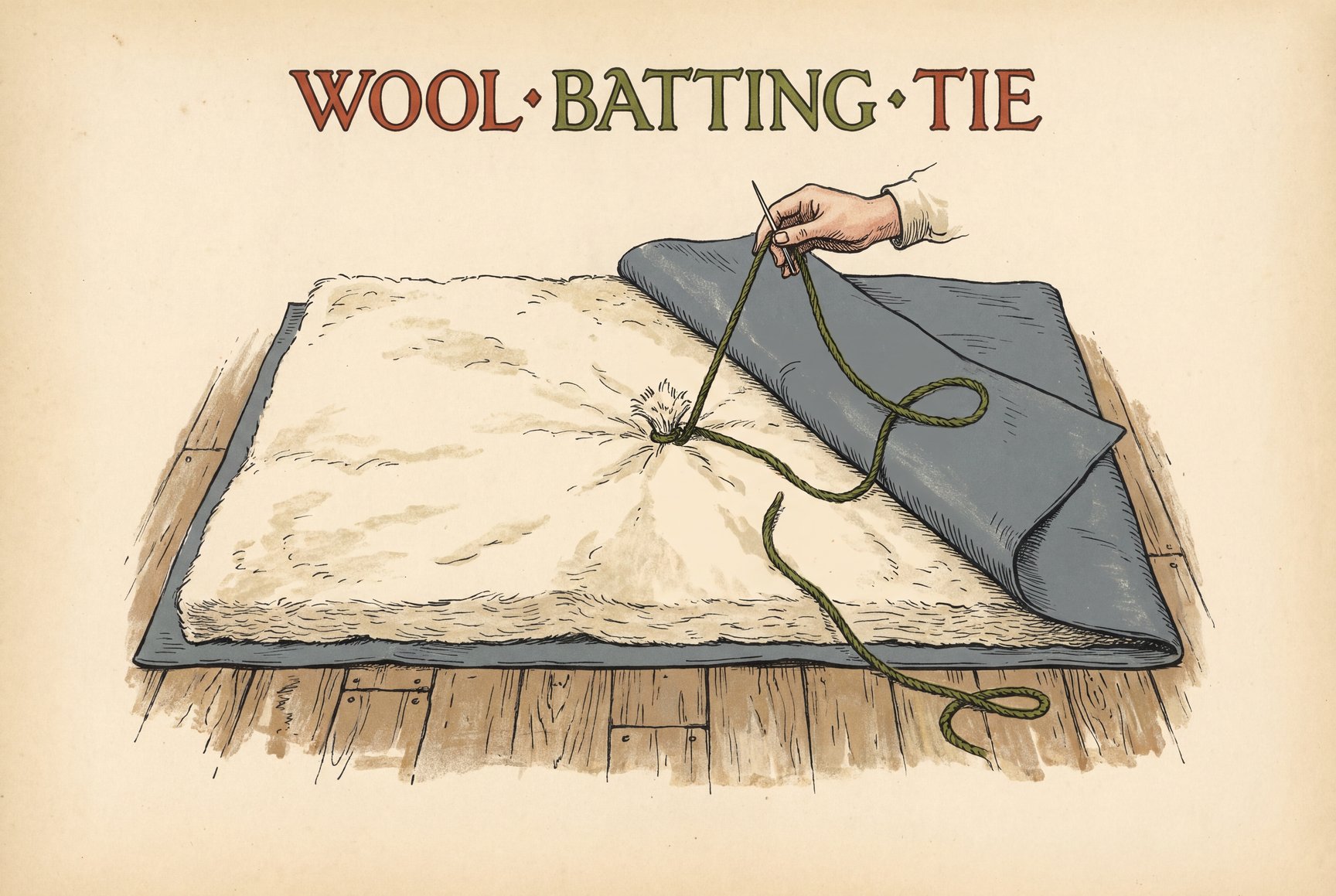
Tie or stitch through all three layers on a regular grid, starting at the center and working out, before you sew any edge shut.
Loose wool drifts over months of use, so something has to pass through all three layers. At home you can do this in two ways. Ties are single stitches knotted on top at points on a grid. Quilted lines are running stitches along channels. Ties are quicker by hand and keep the wool fuller between them, while lines hold thin batting more firmly.
Tie from the middle outward. Becky Utecht puts the first tie in the center, then adds one halfway between it and the edge in all four directions, and keeps adding ties midway between the existing ones (her build notes). Working outward pushes any slack toward the edges, where you can fold it in.
The spacing figures in the table vary widely, because a quilt batting spec and a comforter tie grid answer different questions. The last column is our reading of each figure. No maker publishes it.
| Wool and method | Spacing the source states | Source | Our judgement |
|---|---|---|---|
| Superwashed bonded batting, quilted | Up to 4 in between stitches | Hobbs | A limit for thin batting: stay inside it |
| Unbonded batting by the yard, quilted | 3 in or less | Sonoma Wool Company | Closer than Hobbs because no resin binds the fibers |
| Comforter insert, machine channels | 6 in serpentine channels | St. Peter Woolen Mill | A thick layer holds at this spacing when the stitch line is unbroken |
| Thick comforter, hand ties | Every 9 in | wool-bedding.com | The widest spacing any page we read states, so do not tie wider |
How do you close and finish the edges?
Once the ties hold the wool, fold the raw edges in, pin them, and topstitch close to the edge all the way around the comforter.
Sew the edges last. Becky Utecht sews the folded edges together once enough ties are in place to keep the wool from clumping, and she topstitches close to the edge all the way around, including the side already sewn (Becky Utecht). Folding both raw edges in toward the wool and pinning them gives a clean, closed border without turning the comforter inside out.
The other route is to sew the shell inside out, leave an opening, and turn it right side out, which suits thin quilt batting. A thick layer of wool is hard to work through a small opening without it coming apart, so for comforter-weight wool the fold-and-topstitch finish is the easier choice.
Two details are worth copying from sellers. Many add a row of stitching around the perimeter: Sonoma Wool Company's comforter is hand-tufted, with a row of stitching around the edge to hold the wool in place (Sonoma Wool Company). St. Peter Woolen Mill rounds the corners so the wool fiber stays in place (St. Peter Woolen Mill), which also saves you sewing four bulky square corners. If the comforter will go inside a cover, sew a cotton loop at each corner. Sonoma puts a loop at every corner for duvet ties.
What do sellers' pages say holds the wool inside a finished comforter?
Of fourteen seller pages we read, half say the wool is tied or tufted by hand, five say it is quilted, and two do not say.
We read 14 seller product pages for finished wool comforters on October 19, 2026, one page per seller. For each page we counted what it says holds the wool in place. 7 say the wool is tied or tufted by hand, 5 say it is quilted in boxes, baffles, channels or a pattern, and 2 do not say in the text we read. The tally records what each page claims, and it cannot tell you how any comforter holds up in use.
Three of the seven tufted pages use almost the same wording, so they may describe one maker's product sold by different shops. We still counted each seller's page once. The quilted pages vary in method: Sleep & Beyond uses a box quilted pattern (Sleep & Beyond), and St. Peter Woolen Mill machine quilts its inserts in serpentine channels.
The count matters for a home build in one way. Hand ties are the most common method these sellers state, and ties are also the method you can do best without a machine.
| What the page says holds the wool | Pages | Sellers |
|---|---|---|
| Hand ties or hand tufting | 7 | wool-bedding.com, Sonoma Wool Company, Holy Lamb Organics, Soaring Heart, CozyPure, PlushBeds, wwwwool.com |
| Quilted: box, baffle-box, channel or pattern | 5 | Turmerry, Sleeping Organic, Sleep & Beyond, SheepskinShop, St. Peter Woolen Mill |
| Does not say | 2 | CeCe's Wool, Antipodean Home |
Can you wash a homemade wool comforter without it shrinking?
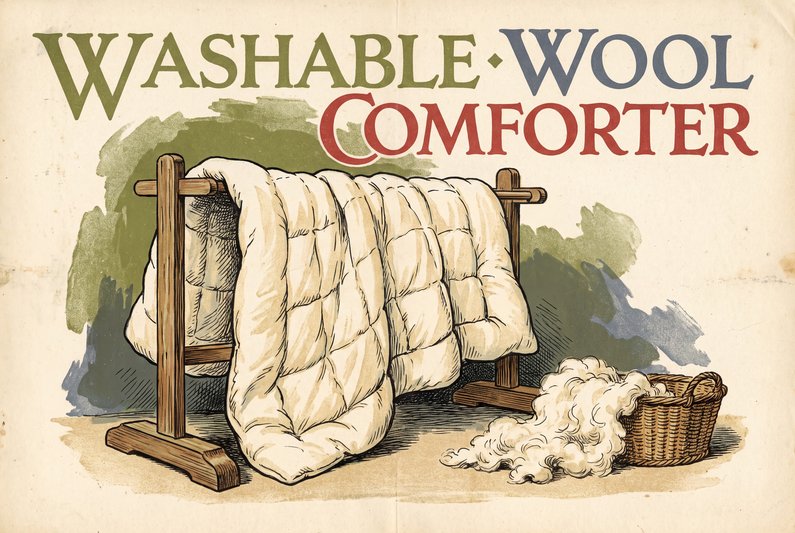
Untreated wool felts and shrinks when heat, water and rubbing meet, so a comforter of plain wool batting should stay out of the washer.
Untreated wool fibers have microscopic scales on their surface, and when wool is agitated in water these scales interlock, which can cause felting and shrinkage, according to The Woolmark Company. Heat and moisture lift the scales, agitation locks them onto neighboring fibers like a ratchet, and the process is irreversible. A loose layer of wool gives fibers plenty of room to move, which makes a comforter more exposed to this than a tightly woven blanket.
Superwash wool has been treated to prevent it. Woolmark uses the term for wool that has had a shrink-resist treatment to make it machine washable. Hobbs says its superwashed batting can be machine washed once it is inside a quilt. One fabric shop lists the care for that batting as delicate cycle and cool water (Stone Mountain Fabric). If you need a comforter that can go in the washer, this is the batting to buy.
Ordinary wool batting has no such treatment, so keep a comforter of untreated wool out of the washing machine. Becky Utecht's own queen comforter became a bit lumpy after years of washing. Sonoma Wool Company recommends hand washing quilted items. The easier habit is to keep a washable cover over the comforter and wash the cover instead. What makes a bought comforter safe for the washer is covered in Can a wool comforter be washed, and what makes one washable?
How do you store a homemade wool comforter so moths leave it alone?
Clothes moth larvae feed mainly on soiled wool, so store the comforter clean, dry and sealed, and check it once each season.
Soiled woolens are the main food of clothes moth larvae, which cannot complete development on clean wool because they need vitamins found only in stained or soiled fabric, says the University of Maryland Extension. Clean wool is the first defense. Air or clean the comforter before you put it away, rather than folding it straight off the bed at the end of winter.
Seal it next. The National Pesticide Information Center advises storing items in airtight bags and containers (NPIC). A homemade comforter folds bulkier than a bought one, so choose a container you can close without forcing the lid onto the wool. Squeezing it hard for months also flattens the layer you spent an afternoon spreading evenly.
Older advice leans on cedar. One farm family that makes its own wool comforters stores them in a cedar chest to keep moths away (Mother Earth News). A cedar chest is a closed box, so it helps for the same reason a sealed bin does. Whatever you use, open it once a season and look along the folds and seams. NPIC describes the larvae as small white caterpillars with dark heads, and you will find them more easily with a flashlight.
Common questions
Short answers to the questions people ask most often, before and after they sew and tie their first wool comforter at home.
Can you use raw fleece instead of bought batting?
Only after it has been washed and carded. Batting is needed because the middle layer has to hold together and not scrunch or wad up, and you can buy wool already washed and carded online, or ask farmers to prepare it for you (Morning Chores). One family makes its own batting on a hand-operated carding machine it bought by mail order (Mother Earth News).
Do you need a sewing machine?
No. Becky Utecht has no quilting equipment and kneels on the quilt to tie it. Tying needs only a long needle and strong thread, so you can do the whole build by hand. A machine only speeds up the perimeter seam.
How long does the build take?
Becky Utecht says the whole project takes only a couple of hours when you start from ready-made batting and tie it. Hand-quilting channels takes far longer, because every line of stitches has to run the full length of the comforter.
Should you pre-wash the wool batting?
No. Linda's says pre-washing Hobbs wool batting is not recommended and to expect some shrinkage in the first wash (Linda's). Never wet untreated wool batting before it is sewn in. Water and handling are two of the three conditions that start felting.
Can you sleep on top of it as a mattress pad?
It is better not to. Sleeping on a comforter mashes down the batting, and it loses some of its insulating value (Mother Earth News). Keep the comforter on top of you and let the wool keep its height.
Why does wool poke through the cotton?
Loose fibers work their way out through open weaves. Becky Utecht finds the wool tends to migrate out of sheets regardless, so she no longer buys expensive sheets for comforters. Hobbs says its bonded batting resists bearding and migration, which are the quilting words for this problem. A tighter-woven cotton shell slows it down.
Sources
Outside reading behind this wool duvet page, each entry marked with where on the page it is used.
- wool-bedding.com (wool-bedding.com), used under “Key Takeaways”; “How much wool batting does a comforter need for each bed size?”; “How do you stop the wool from shifting and clumping?”; “What do sellers' pages say holds the wool inside a finished comforter?”.
- lightweight (wool-bedding.com), used under “Key Takeaways”; “How much wool batting does a comforter need for each bed size?”.
- Hobbs (hobbsbatting.com), used under “Key Takeaways”; “What do you need to make a wool comforter at home?”; “How do you stop the wool from shifting and clumping?”.
- Rustic Roots Farm (rusticrootsfarm.com), used under “What do you need to make a wool comforter at home?”.
- Morning Chores (morningchores.com), used under “What do you need to make a wool comforter at home?”; “Common questions”.
- Becky Utecht (riveroaksfarmstudioblog.blogspot.com), used under “What do you need to make a wool comforter at home?”; “How do you lay the batting inside the cotton shell?”; “How do you stop the wool from shifting and clumping?”; “How do you close and finish the edges?”.
- Sonoma Wool Company (sonomawoolcompany.com), used under “How much wool batting does a comforter need for each bed size?”; “How do you stop the wool from shifting and clumping?”.
- St. Peter Woolen Mill (woolenmill.com), used under “How do you stop the wool from shifting and clumping?”; “How do you close and finish the edges?”; “What do sellers' pages say holds the wool inside a finished comforter?”.
- Sonoma Wool Company (sonomawoolcompany.com), used under “How do you close and finish the edges?”; “What do sellers' pages say holds the wool inside a finished comforter?”.
- Sleep & Beyond (sleepandbeyond.com), used under “What do sellers' pages say holds the wool inside a finished comforter?”.
- Holy Lamb Organics (holylamborganics.com), used under “What do sellers' pages say holds the wool inside a finished comforter?”.
- Soaring Heart (soaringheart.com), used under “What do sellers' pages say holds the wool inside a finished comforter?”.
- CozyPure (cozypure.com), used under “What do sellers' pages say holds the wool inside a finished comforter?”.
- PlushBeds (plushbeds.com), used under “What do sellers' pages say holds the wool inside a finished comforter?”.
- wwwwool.com (wwwwool.com), used under “What do sellers' pages say holds the wool inside a finished comforter?”.
- Turmerry (turmerry.com), used under “What do sellers' pages say holds the wool inside a finished comforter?”.
- SheepskinShop (sheepskinshop.com), used under “What do sellers' pages say holds the wool inside a finished comforter?”.
- CeCe's Wool (ceceswool.com), used under “What do sellers' pages say holds the wool inside a finished comforter?”.
- Antipodean Home (antipodean-home.com), used under “What do sellers' pages say holds the wool inside a finished comforter?”.
- The Woolmark Company (woolmark.com), used under “Can you wash a homemade wool comforter without it shrinking?”.
- Stone Mountain Fabric (stonemountainfabric.com), used under “Can you wash a homemade wool comforter without it shrinking?”.
- University of Maryland Extension (extension.umd.edu), used under “How do you store a homemade wool comforter so moths leave it alone?”.
- NPIC (npic.orst.edu), used under “How do you store a homemade wool comforter so moths leave it alone?”.
- Mother Earth News (motherearthnews.com), used under “How do you store a homemade wool comforter so moths leave it alone?”; “Common questions”.
- Linda's (lindas.com), used under “Common questions”.