Should you own a lighter and a heavier wool duvet instead of one?
Updated .
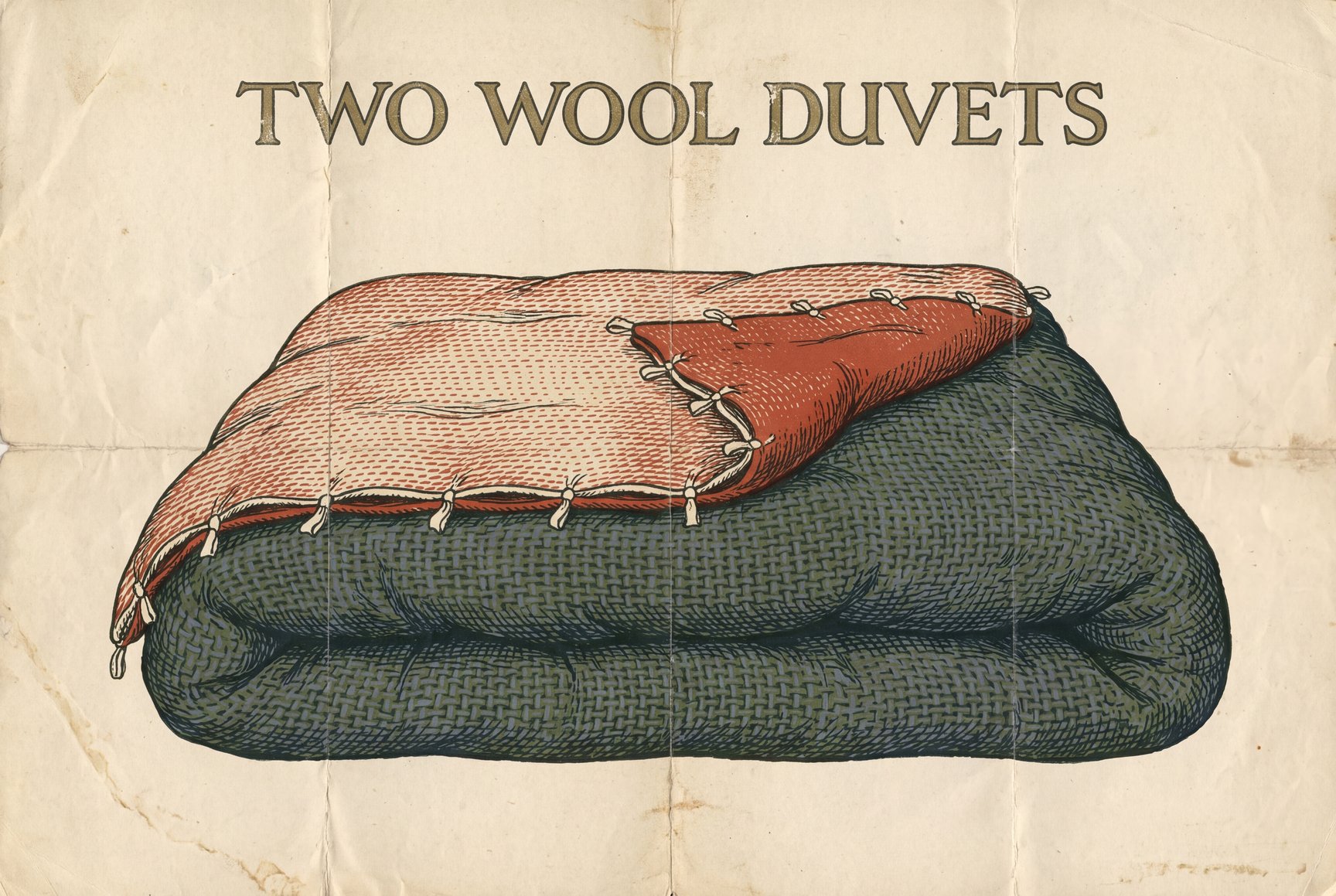
One duvet has to get a sleeper through a humid July night and a January night with the heat turned down, and one weight rarely handles both. The two-duvet system gives that job to two layers, a light one and a heavier one, joined together when winter needs both.
Short answer: Buy two wool duvets instead of one if your bedroom's temperature changes a lot between seasons. Use the light one alone in summer and the heavier one in spring and fall, then fasten both together in winter. UK sets usually pair a 4.5 tog layer with a 9 tog layer for 13.5 tog (Scooms). One US seller's snap-together queen/full set holds 6.3 lb of wool across its light and medium layers (Woolroom). If a home holds steady all year, one mid-weight duvet is simpler.
This guide is for: people whose bedroom runs warm in summer and cool in winter, who sleep under wool or plan to, and who want to know whether a second duvet is worth the closet space.
Key Takeaways
The three points below carry the figures that matter most, each drawn from a source linked further down the page in its own section.
- Sellers add the two ratings together. The most common British set joins a 4.5 tog duvet to a 9 tog duvet to make 13.5 tog (Scooms), and each half also works alone for its own season.
- A joined pair can hold more wool than a single winter comforter. Woolroom's queen/full all season pair holds 6.3 lb of wool (Woolroom), against 5.3 lb in its single warm comforter (Woolroom).
- Only 3 of the 8 US product pages we read give a bedroom temperature in degrees. Four describe warmth only in words such as summer or all climates, and one gives only a fill weight. You will often have to work out what a label means for your own bedroom.
On This Page
Each entry below matches a section heading on this page word for word, so you can jump straight to the question you came here to ask.
What is the two-duvet system, and how does it work?
You own a light duvet and a heavier one, use either alone as the season changes, and fasten them together on the coldest nights of winter.
The idea comes from British bedding, where the pair is sold as an "all seasons" duvet. It is two separate duvets, a light summer layer and a warmer one, and each can be used alone or fastened to the other for colder nights (Soak&Sleep). Two duvets give 3 settings: light, medium, and both together.
American shops usually say comforter. One US seller states that a wool duvet, a duvet insert and a wool comforter are one product, and that the name people use depends on where they live (Woolroom). Either word works in a search, and both turn up comforters built this way.
The case for two layers is simple: a bedroom does not stay at one temperature all year. A review of sleep research found that both heat and cold exposure increase wakefulness and reduce rapid eye movement and slow wave sleep, and that the effects differ with the bedding and clothing people use (Okamoto-Mizuno and Mizuno). With one compromise duvet, a sleeper spends much of the year a little too warm or too cool. Two layers let you adjust in steps instead of settling for the middle.
The pair also doubles as a spare. Sellers point out that it leaves a spare duvet for house guests (Soak&Sleep). That helps where a guest bed would otherwise need bedding of its own.
How warm is each layer, and do the two add up?
Warmth ratings roughly add when two layers are joined, but a heavier fill gives less extra warmth per ounce than the first layer did.
British duvets are rated in tog, a unit of thermal resistance. The tog value of a duvet is measured on a togmeter under a British Standard, and an adult winter duvet usually falls between 10 and 15 tog, with summer duvets far lower (IDFL). The rating measures how well a layer resists heat flow, so stacking two layers roughly adds their ratings. That is why sellers add the two numbers on the label.
That sum should be treated as the best case. A thermal manikin study found that, whatever the filling, insulation rises with fill weight but at a decelerating rate (Zhang et al.). Doubling the wool on a bed does not double the warmth you feel. Zhang and colleagues also found that coverage mattered a great deal, with insulation falling sharply as the bedding covered less of the body. A leg or shoulder left out already makes the bedding less warm.
Wool comforters sold in the United States rarely carry a tog rating. Sellers label them by fill weight instead, either per square yard or as a total for each bed size. Our guide on how to convert a wool duvet's GSM to tog explains how the two systems line up. Comparing weights at the same size tells you more than a season name does, because a label such as "light" can mean different amounts of wool from one seller to the next.
Which weight pairs do US sellers offer?
Two patterns exist: a light layer paired with a medium one, or two equal light layers that tie together, and both are sold in US sizes.
| Set | Lighter layer | Heavier layer | Joined |
|---|---|---|---|
| Woolroom all season, queen/full | Light: 2.1 lb when sold alone (Woolroom) | Medium: 4.2 lb in the Classic line (Woolroom) | 6.3 lb (Woolroom) |
| Holy Lamb Organics All-Season, full/queen | Slightly lighter than its Light weight | Equal to the first layer | Two equal layers tied together (Holy Lamb Organics) |
| Common UK set | 4.5 tog | 9 tog | 13.5 tog (Scooms) |
Holy Lamb Organics joins two comforters, each slightly lighter than its Light weight, with cotton ties, so owners tie them together in colder weather and separate them as it warms (Holy Lamb Organics).
An unequal pair gives 3 distinct settings, while an equal pair gives 2. With an equal pair, either half feels the same when used alone. If your spring and fall call for something between summer and winter, an unequal pair such as Woolroom's 2.1 lb light and 4.2 lb medium layers covers that middle. Where a year is mostly hot months and cold months with little in between, an equal pair is enough.
UK shops offer a wider range of pairs, from light combinations to very warm ones (Soak&Sleep). They come in single, double, king and super king, which are British sizes, so check the dimensions against your bed. Our guide to what size wool comforter you need for a king or queen bed covers the measurements. Before buying any set, check whether the heavier layer is also sold on its own, since that decides whether a single duvet can grow into a pair later.
How do you match each layer to your bedroom temperature?
Start from the temperature your bedroom holds overnight, then pick the lightest layer that keeps you warm there without a second cover.
Research gives no single number to aim for. A review of sleep research found that the effects of heat and cold on sleep differ depending on the bedding and clothing people use (Okamoto-Mizuno and Mizuno), which is why one room can suit one duvet and feel wrong under another. One seller links each of its weights to a room temperature:
| Layer | Room temperature the seller states | Queen fill the seller states | How a two-duvet owner might use it (our judgement) |
|---|---|---|---|
| Light | 68°F and above (Woolroom) | 2.1 lb | Alone in summer, or in any bedroom that stays warm |
| Medium | 60 to 68°F (Woolroom) | 4.2 lb | Alone in spring and fall |
| Warm | 48 to 60°F (Woolroom) | 5.3 lb (Woolroom) | Light and medium joined hold more wool than this |
The last column is our reading, not the seller's. Joining the light and medium layers puts 6.3 lb of wool on the bed, 1 lb more than the 5.3 lb single warm comforter. On paper, then, the joined pair should cover the warm range, bearing in mind that extra fill adds warmth at a slowing rate.
Check the room before buying. A cheap thermometer read at bedtime and again before dawn shows you which rows apply to your bedroom. If your bedroom stays inside one row all year, the duvet for that row may be all you need.
Are two duvets better than one all-season duvet?
Two layers win if your bedroom swings by season; one mid-weight duvet wins if your home holds a steady temperature all year round.
| Setup | Where it works | Where it falls short | Our judgement |
|---|---|---|---|
| One mid-weight duvet all year | Homes with steady heating and cooling | Hot summers and cold winters | Simplest; fine if the bedroom stays in one band |
| One duvet plus a blanket in winter | Adds warmth without a second duvet | Blanket shifts; two things to make up | Cheapest step up |
| Light and medium pair | Three settings through the year | Two items to buy, cover and store | Widest range of these four |
| Two equal light layers | Joins evenly; one weight to buy | Only two settings | Enough where spring and fall are short |
The judgement column is our reasoning from the specifications and research on this page. It does not come from sleeping under any of them.
The blanket route has a seller's support. Holy Lamb describes its Perfect weight as its most popular, comfortable in spring and summer, with a blanket added in cooler months as needed (Holy Lamb Organics). Holy Lamb also sells a two-layer set, so it treats both routes as reasonable.
Two duvets make sense when a bedroom crosses more than one temperature band in a year. That may describe your home if it lacks central air, or your bedroom if you cool it in summer and keep it cool in winter. Sellers also say a matched set often costs less than two duvets bought separately (Scooms). If your apartment holds one temperature in every season, you need only one duvet, which takes half the space.
What do wool comforter product pages tell you about warmth?
Half the pages we read describe warmth only in words such as summer or warm climates, and three give a bedroom temperature in degrees.
We read 8 product pages for wool comforters sold in US sizes on September 27, 2026, and sorted each by what the seller's own text says about warmth. We counted statements on the pages and did not handle or use any product.
| What the seller's text states | Pages | Which pages |
|---|---|---|
| A bedroom temperature in degrees | 3 | Woolroom Deluxe Light, Classic Medium, Organic Warm |
| Season or climate words only | 4 | Woolroom All Season; Holy Lamb All-Season and Wool Comforter; Sleep & Beyond Light |
| A fill weight, but no season or temperature | 1 | CeCe's Wool Queen Comforter |
Two details shaped the count. Woolroom's all season page says only that the design suits all climates and room temperatures, so it went in the words bucket even though Woolroom gives degrees for its single layers. A shopper review on one Holy Lamb page mentions a room temperature, but we counted only the seller's own text. CeCe's Wool states the fill weight of its queen comforter and says wool adjusts to body temperature, with no season or room range attached.
These 8 pages are a small, defined set, not a survey of the market. They still show what a shopper will run into. When a page names a season instead of a temperature, ask the seller for the fill weight per square yard or a room range before you buy.
How should the two layers fasten together?
Snaps or ties along every edge keep the layers lined up; corner-only fastenings let the lower layer slide and bunch inside the cover.
Duvets are joined with buttons, ties or plastic fasteners (Homescapes). Woolroom says its integrated poppers make it easy to change the warmth level (Woolroom). A buyer on its all season page noted that the snaps run along the entire perimeter so both pieces stay aligned, and preferred them to tied corners that shift (Woolroom). That is one person's view, but it fits how fastenings work: a fastening at every edge holds the layers flat against each other.
Ties need sturdy stitching. One Holy Lamb reviewer reported a tie ripping off and suggested an extra tie on each side or more reinforcement in the stitching (Holy Lamb Organics). You can sew a tie back on easily, which counts in their favor.
Before buying, check where the fastenings sit, how many there are, and whether spares are available. One UK seller hand-stitches matching buttonholes on its duvets and will add a fastener pack on request (Scooms). Your duvet cover's corners matter too. Holy Lamb's comforters carry corner ties for securing into a duvet cover (Holy Lamb Organics), which keeps the joined pair from sliding to the foot of the bed.
Where do you keep the duvet you are not using?
Store the resting layer clean, dry and loosely folded in a breathable cotton bag, never vacuum-sealed, somewhere cool and away from light.
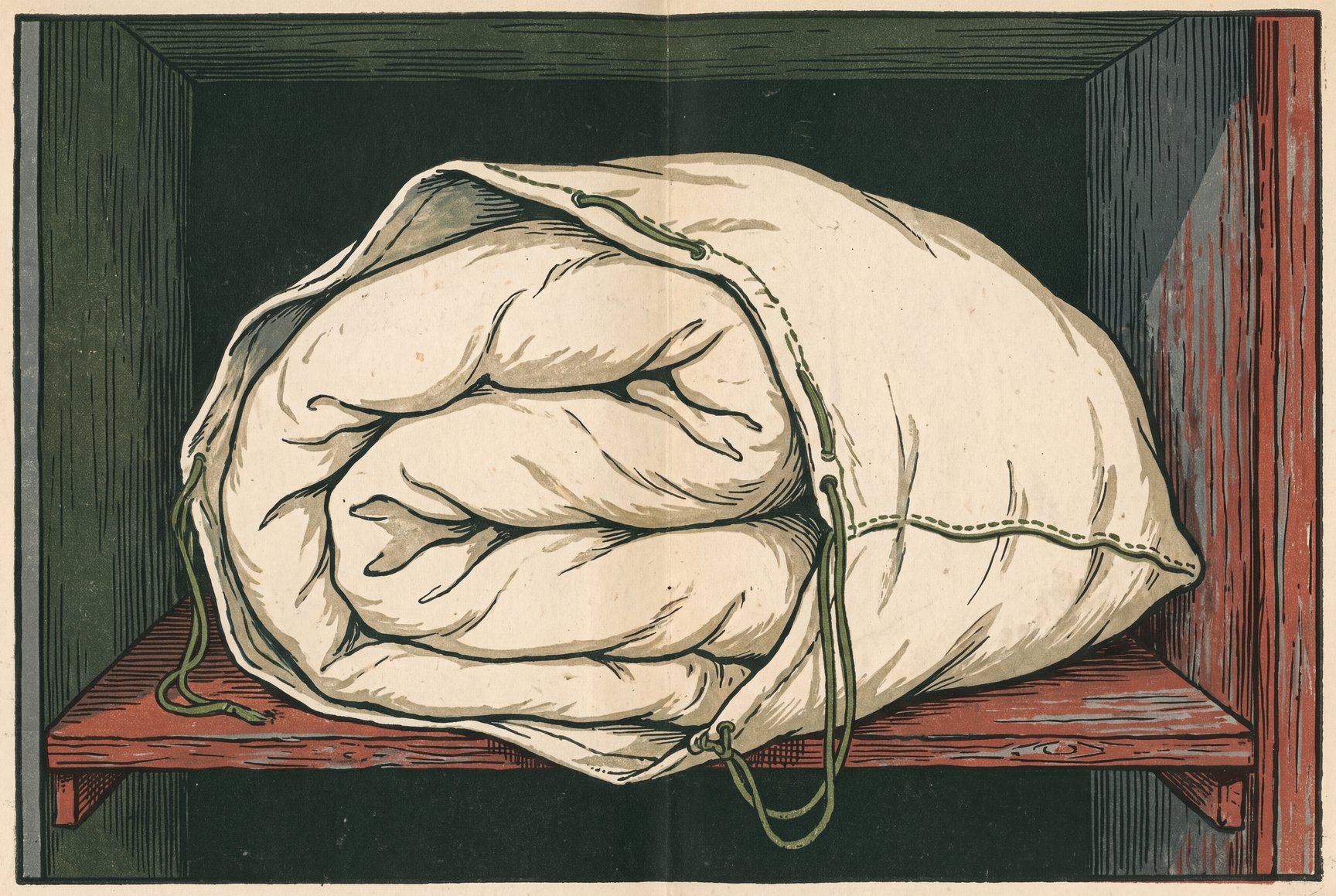
Start with what the sellers say. Woolroom states that its washable light comforter is not suitable for vacuum storage (Woolroom). Scooms supplies its duvets in a cotton bag so one can be stored while the other is in use (Scooms). A cotton bag keeps dust off and lets air move through the fill, which a sealed plastic bag does not.
Clean the layer before you put it away, since wool stored soiled is what moths look for. How you clean it depends on the product line. Woolroom's washable line calls for a wool cycle with wool detergent, a slow spin and line drying, with no tumble drying. Its Classic line should go to a dry cleaner (Woolroom). Holy Lamb advises sunning wool bedding a few times a year and, when a full wash is needed, a cold soak and spin only, never the agitating wash cycle (Holy Lamb Organics care). Our guide to what a washable wool comforter is explains why some wool survives the machine and some does not.
Air the stored layer in daylight for an afternoon before it goes back on the bed. Your closet shelf beats a damp basement or a hot attic, and a loose fold keeps the fill from being pressed flat for months.
Common questions
Short answers to the questions that come up when you run two wool duvets, from sizing and washing to sharing a bed with someone.
Can you buy the second duvet later?
Often, yes. Scooms says a single duvet can be turned into an all seasons set later because its duvets have matching buttonholes (Scooms). Stay within one product line so your sizes and fastenings match.
Will one duvet cover hold both layers?
Usually. Holy Lamb says its joined pair fits inside a duvet cover with ease (Holy Lamb Organics). Choose a cover with a little room, because two quilted layers take up more space than one.
Is the joined pair heavier than one winter duvet?
In one line, yes. Woolroom's joined queen/full pair holds 6.3 lb of wool (Woolroom), while its single warm comforter holds 5.3 lb (Woolroom). If you dislike heavy bedding, try the light layer with a blanket.
What if you and your partner want different warmth?
That calls for a different split. Holy Lamb's Dual Weight comforter has two halves of different weights for co-sleepers (EarthHero). Stacked layers change the warmth for both sleepers; side-by-side halves change it for one person.
Can you wash both layers at home?
That depends on the line. Some wool is treated to survive the machine, some goes to a dry cleaner, and some only tolerates a soak and spin. Read the care section before you buy.
Do you need a tog rating to compare wool duvets?
No. US sellers label wool by weight, so you can compare ounces per square yard, or total fill at the same size. The GSM guide linked above shows how weight relates to tog.
Sources
Outside reading behind this wool duvet page, each entry marked with where on the page it is used.
- Scooms (scooms.com), used under “Key Takeaways”; “Which weight pairs do US sellers offer?”; “Are two duvets better than one all-season duvet?”; “Where do you keep the duvet you are not using?”.
- Woolroom (thewoolroom.com), used under “Key Takeaways”; “Which weight pairs do US sellers offer?”; “What do wool comforter product pages tell you about warmth?”; “Common questions”.
- Woolroom (thewoolroom.com), used under “Key Takeaways”; “How do you match each layer to your bedroom temperature?”; “Common questions”.
- Soak&Sleep (soakandsleep.com), used under “What is the two-duvet system, and how does it work?”; “Which weight pairs do US sellers offer?”.
- Woolroom (thewoolroom.com), used under “What is the two-duvet system, and how does it work?”; “Which weight pairs do US sellers offer?”; “How do you match each layer to your bedroom temperature?”; “What do wool comforter product pages tell you about warmth?”; “Where do you keep the duvet you are not using?”.
- Okamoto-Mizuno and Mizuno (ncbi.nlm.nih.gov), used under “What is the two-duvet system, and how does it work?”; “How do you match each layer to your bedroom temperature?”.
- IDFL (idfl.com), used under “How warm is each layer, and do the two add up?”.
- Zhang et al. (sciencedirect.com), used under “How warm is each layer, and do the two add up?”.
- Woolroom (thewoolroom.com), used under “Which weight pairs do US sellers offer?”; “How do you match each layer to your bedroom temperature?”; “What do wool comforter product pages tell you about warmth?”.
- Holy Lamb Organics (holylamborganics.com), used under “Which weight pairs do US sellers offer?”; “What do wool comforter product pages tell you about warmth?”; “How should the two layers fasten together?”; “Common questions”.
- Woolroom (thewoolroom.com), used under “How do you match each layer to your bedroom temperature?”; “What do wool comforter product pages tell you about warmth?”.
- Holy Lamb Organics (holylamborganics.com), used under “Are two duvets better than one all-season duvet?”.
- Wool Comforter (holylamborganics.com), used under “What do wool comforter product pages tell you about warmth?”; “How should the two layers fasten together?”.
- Light (sleepandbeyond.com), used under “What do wool comforter product pages tell you about warmth?”.
- Queen Comforter (ceceswool.com), used under “What do wool comforter product pages tell you about warmth?”.
- Homescapes (homescapesonline.com), used under “How should the two layers fasten together?”.
- Woolroom (thewoolroom.com), used under “How should the two layers fasten together?”.
- Woolroom (thewoolroom.com), used under “How should the two layers fasten together?”.
- Scooms (scooms.com), used under “How should the two layers fasten together?”; “Common questions”.
- Woolroom (thewoolroom.com), used under “Where do you keep the duvet you are not using?”.
- Holy Lamb Organics care (holylamborganics.com), used under “Where do you keep the duvet you are not using?”.
- EarthHero (earthhero.com), used under “Common questions”.